Bridgeport-Stamford-Danbury Roofer Salary, Safety & Workforce Benchmarks (2026)
Roofers in the Bridgeport-Stamford-Danbury metro earned a median of $81,310 a year ($39.09 an hour) in May 2025, 47% more than the national roofer median of $55,440. They also work in one of the most dangerous jobs in the country: roofers died on the job at a rate of 48.7 per 100,000 full-time workers in 2024, and Connecticut's workers' compensation benchmark for roofing is $10.59 for every $100 of payroll. This report puts those numbers side by side so Stamford homeowners can see why a registered, insured roofer's quote costs what it does, and how to tell it apart from a storm chaser's.
- The Bridgeport-Stamford-Danbury metro had 130 payroll roofers in May 2025 with a median wage of $39.09 an hour, or $81,310 a year (BLS OEWS).
- That metro median is 31% above Connecticut's statewide roofer median of $62,070 and 47% above the U.S. median of $55,440 (BLS OEWS).
- Stamford-area roofers out-earn the New York (median $76,400), Boston ($66,350), Hartford ($65,710) and New Haven ($60,800) metros (BLS OEWS).
- The top 10% of Bridgeport-Stamford-Danbury roofers earn more than $99,130 a year; the bottom 10% earn less than $49,950 (BLS OEWS).
- 104 roofers died on the job in 2024, a fatality rate of 48.7 per 100,000 full-time workers, nearly 15 times the 3.3 rate for all U.S. workers (BLS CFOI).
- Falls, slips and trips caused 96 of the 120 deaths at roofing contracting firms in 2024 (BLS CFOI Table A-1).
- Roofing contractors reported 1.1 injury cases involving days away from work per 100 full-time workers in 2024, versus 0.8 across private industry (BLS SOII).
- Fall protection in construction was again OSHA's most frequently cited standard in fiscal 2026 (OSHA).
- Connecticut's 2026 workers' comp loss cost for roofing (class 5551) is $10.587 per $100 of payroll, about 149 times the $0.071 for office clerical work (NCCI filing, CT Insurance Department).
- In the state's assigned risk market, roofing comp costs $19.596 per $100 of payroll with a $1,500 minimum premium (NCCI filing).
- U.S. construction employers paid $15.84 an hour in benefits on top of $36.13 in wages in June 2026 (BLS ECEC).
- Registering as a Connecticut home improvement contractor costs a $220 nonrefundable fee and requires at least $20,000 of general liability insurance (CT DCP).
- Homeowners who hired a registered contractor can recover up to $25,000 from the state's Home Improvement Guaranty Fund (CT DCP).
- New residential construction made up 21% of U.S. residential roofing demand in 2022; the rest is mostly reroofing existing homes (Freedonia Group).
- Roofer employment is projected to grow 5% from 2025 to 2035, with about 12,000 openings a year (BLS Occupational Outlook Handbook).
1. How Much Do Roofers Make in Stamford, CT?
The Bureau of Labor Statistics' Occupational Employment and Wage Statistics (OEWS) survey is the standard source for pay by occupation and place. Stamford falls in the Bridgeport-Stamford-Danbury, CT metropolitan area (BLS area code 14860), which includes Stamford, Bridgeport, Norwalk and Danbury. The May 2025 estimates, the latest available, cover roofers (occupation code 47-2181) who work for payroll employers; self-employed roofers are not counted.
| Roofers, Bridgeport-Stamford-Danbury (May 2025) | Value | Source |
|---|---|---|
| Employment | 130 | BLS OEWS |
| Median hourly wage | $39.09 | BLS OEWS |
| Median annual wage | $81,310 | BLS OEWS |
| Mean hourly wage | $37.65 | BLS OEWS |
| Mean annual wage | $78,320 | BLS OEWS |
| Hourly wage, 10th to 90th percentile | $24.01 to $47.66 | BLS OEWS |
| Annual wage, 10th to 90th percentile | $49,950 to $99,130 | BLS OEWS |
The median sits above the mean here ($39.09 versus $37.65 an hour), which suggests many local roofers are paid close to the top of the range (the 75th and 90th percentiles are both near $47.50 an hour). With only about 130 payroll roofers in the metro, these figures rest on a small survey sample and can shift from one year to the next. They still give a homeowner a fair sense of what the crew on a Stamford roof is paid.
2. Stamford vs. Connecticut vs. Nearby Metros
Roofer pay in Fairfield County runs well above the rest of Connecticut and the country, and even above the New York metro next door. The table compares median annual wages for the same occupation across the region.
| Area (May 2025) | Roofers employed | Median hourly | Median annual | Source |
|---|---|---|---|---|
| Bridgeport-Stamford-Danbury, CT | 130 | $39.09 | $81,310 | BLS OEWS |
| New York-Newark-Jersey City | 3,100 | $36.73 | $76,400 | BLS OEWS |
| Boston-Cambridge-Newton | 1,120 | $31.90 | $66,350 | BLS OEWS |
| Hartford metro | 350 | $31.59 | $65,710 | BLS OEWS |
| Connecticut (statewide) | 790 | $29.84 | $62,070 | BLS OEWS |
| New Haven metro | 180 | $29.23 | $60,800 | BLS OEWS |
| United States | 135,490 | $26.65 | $55,440 | BLS OEWS |
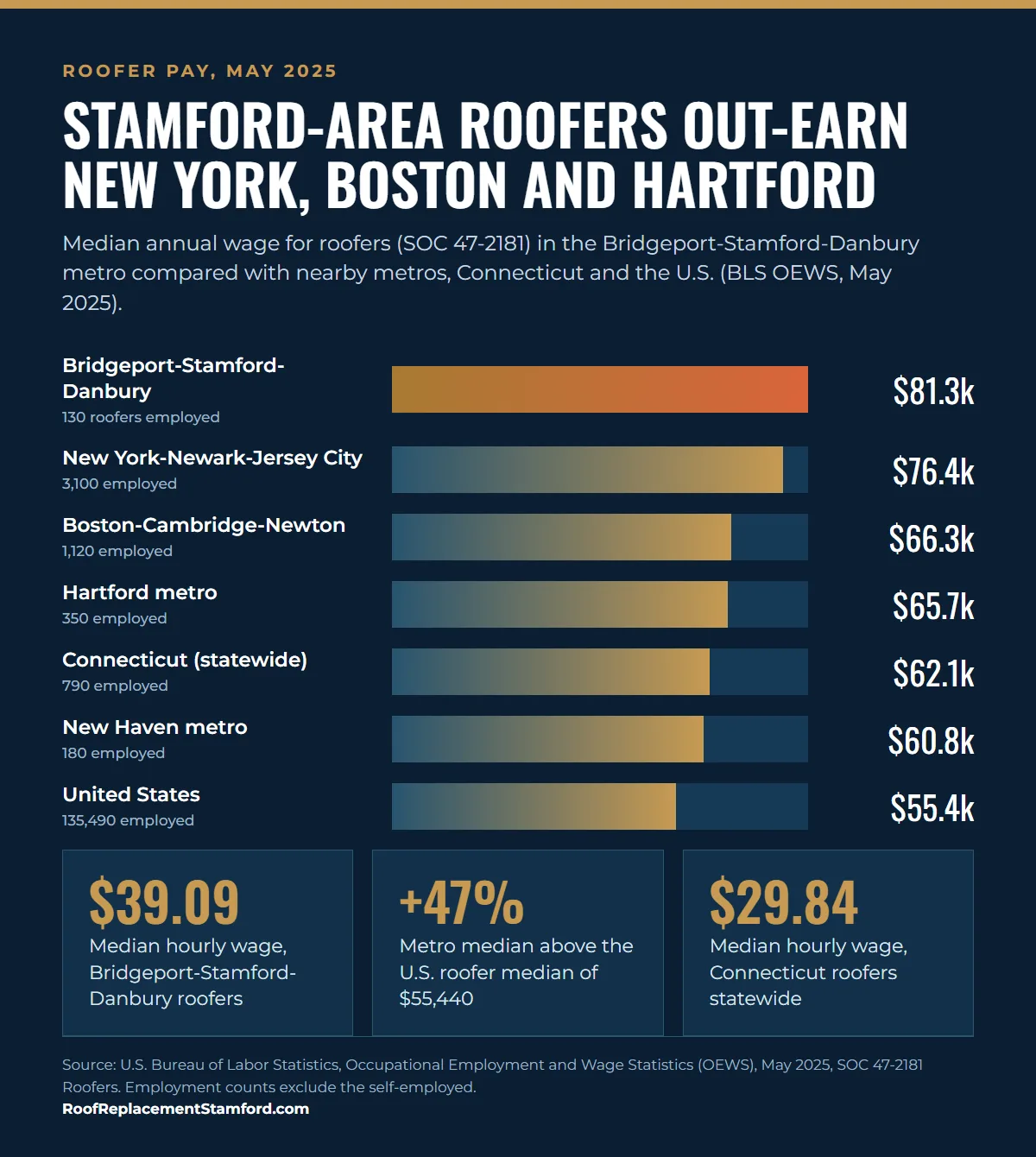
Higher local pay is one reason Fairfield County roofing labor costs more than the national averages quoted on cost-guide websites; our Stamford roof replacement cost index shows what that means per square foot. Pay is only part of what a contractor spends per labor hour, as the next sections show.
3. The Full Roofer Pay Range
OEWS publishes wage percentiles, which show the spread from newer crew members to the highest-paid installers and foremen working as roofers. In the Stamford metro the 75th and 90th percentiles sit close together, near $99,000 a year.
| Annual wage (May 2025) | Bridgeport-Stamford-Danbury | Connecticut | United States |
|---|---|---|---|
| 10th percentile | $49,950 | $47,730 | $37,460 |
| 25th percentile | $55,890 | $51,580 | $46,260 |
| Median | $81,310 | $62,070 | $55,440 |
| 75th percentile | $98,540 | $93,450 | $65,390 |
| 90th percentile | $99,130 | $96,070 | $81,720 |
| Mean | $78,320 | $68,490 | $58,140 |
| Source | BLS OEWS | BLS OEWS | BLS OEWS |
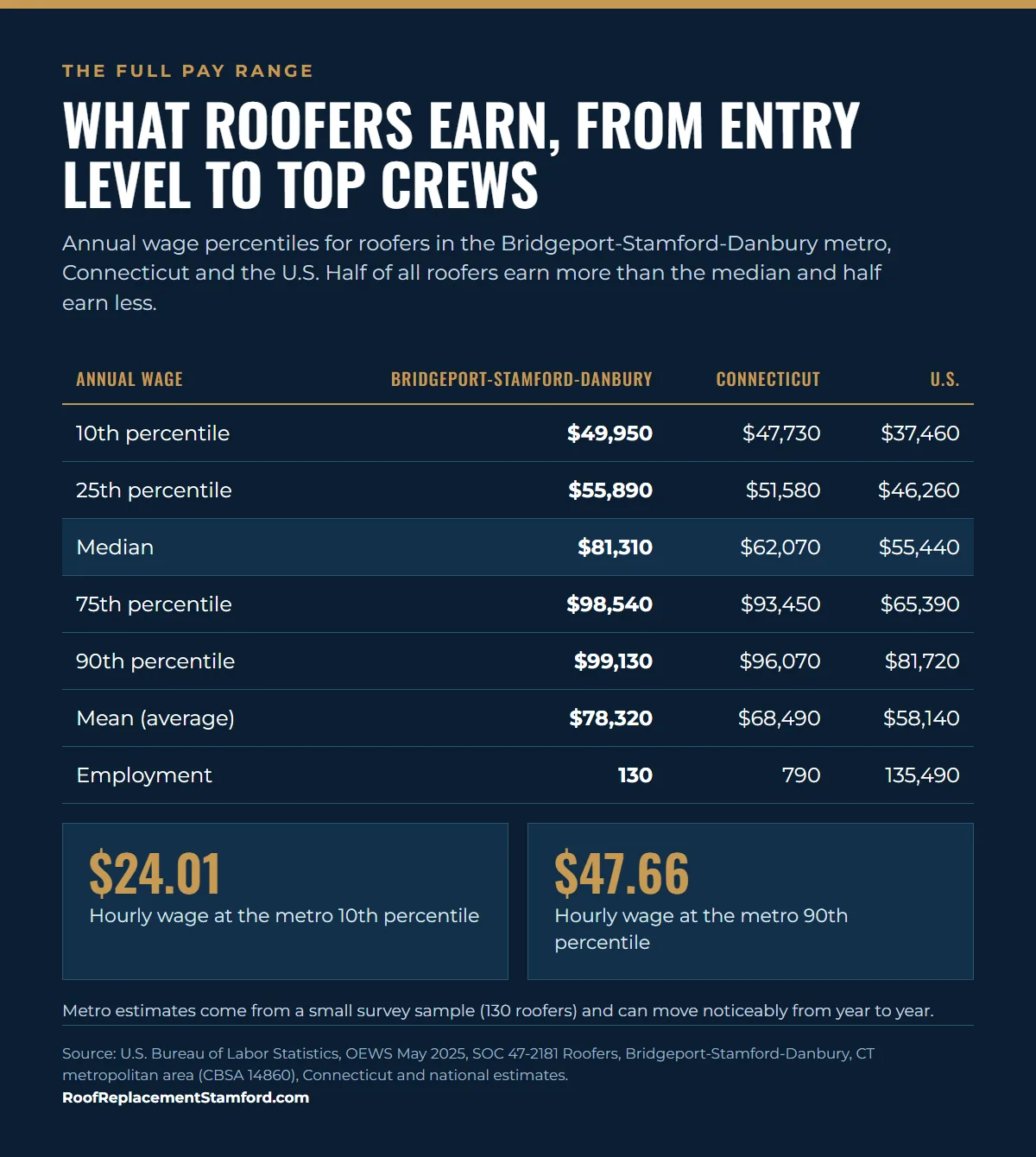
Even the lowest-paid tenth of Stamford-area roofers earns more than the national 25th percentile. A crew of three or four on a residential re-roof is likely to include people across this range, from a helper near the bottom to a lead installer near the top.
4. From Hourly Wage to Labor Cost: Why Quotes Run Higher Than Pay
A roofer's wage is not what a contractor spends for each hour that roofer works. Employers also pay for benefits and legally required insurance, and a roofing company carries costs that most trades do not. The BLS Employer Costs for Employee Compensation survey measures that gap for the construction industry as a whole.
| Cost per hour worked, U.S. construction (June 2026) | Value | Source |
|---|---|---|
| Wages and salaries | $36.13 | BLS ECEC |
| Total benefits (insurance, retirement, paid leave, legally required benefits) | $15.84 | BLS ECEC |
| Total compensation | $51.97 | BLS ECEC |
| Benefits as a share of total compensation | 30.5% | Calculated from BLS ECEC |
| All private industry: wages / benefits | $32.82 / $14.07 | BLS ECEC |
Cost-guide websites often quote roofing labor at a flat hourly range, such as $40 to $90 an hour. We could not trace any such range to a primary survey, so this report does not use one. What the federal data does show is that a Stamford-area roofer earning the $39.09 median costs an employer considerably more than that per hour once benefits, payroll taxes and roofing's high workers' comp rate are added, before any equipment, disposal, permits, overhead or profit. That is why an hourly "labor rate" on a legitimate quote will always sit well above what the crew takes home.
5. Roofer Fatality Rates: One of the Most Dangerous Jobs in America
The BLS Census of Fatal Occupational Injuries (CFOI) counts every work-related death in the U.S. In 2024 it recorded 5,070 fatal work injuries, a rate of 3.3 per 100,000 full-time equivalent workers. Roofers died at a rate of 48.7, behind only logging and fishing among the occupations BLS highlights.
| Occupation (2024) | Fatal injury rate per 100,000 FTE | Deaths | Source |
|---|---|---|---|
| Logging workers | 110.4 | 51 | BLS CFOI |
| Fishing and hunting workers | 88.8 | 24 | BLS CFOI |
| Roofers | 48.7 | 104 | BLS CFOI |
| Structural iron and steel workers | 37.8 | 14 | BLS CFOI |
| Helpers, construction trades | 35.8 | 18 | BLS CFOI |
| Construction laborers | 15.8 | 334 | BLS CFOI |
| Carpenters | 7.5 | 89 | BLS CFOI |
| Electricians | 5.3 | 53 | BLS CFOI |
| All workers | 3.3 | 5,070 | BLS CFOI |
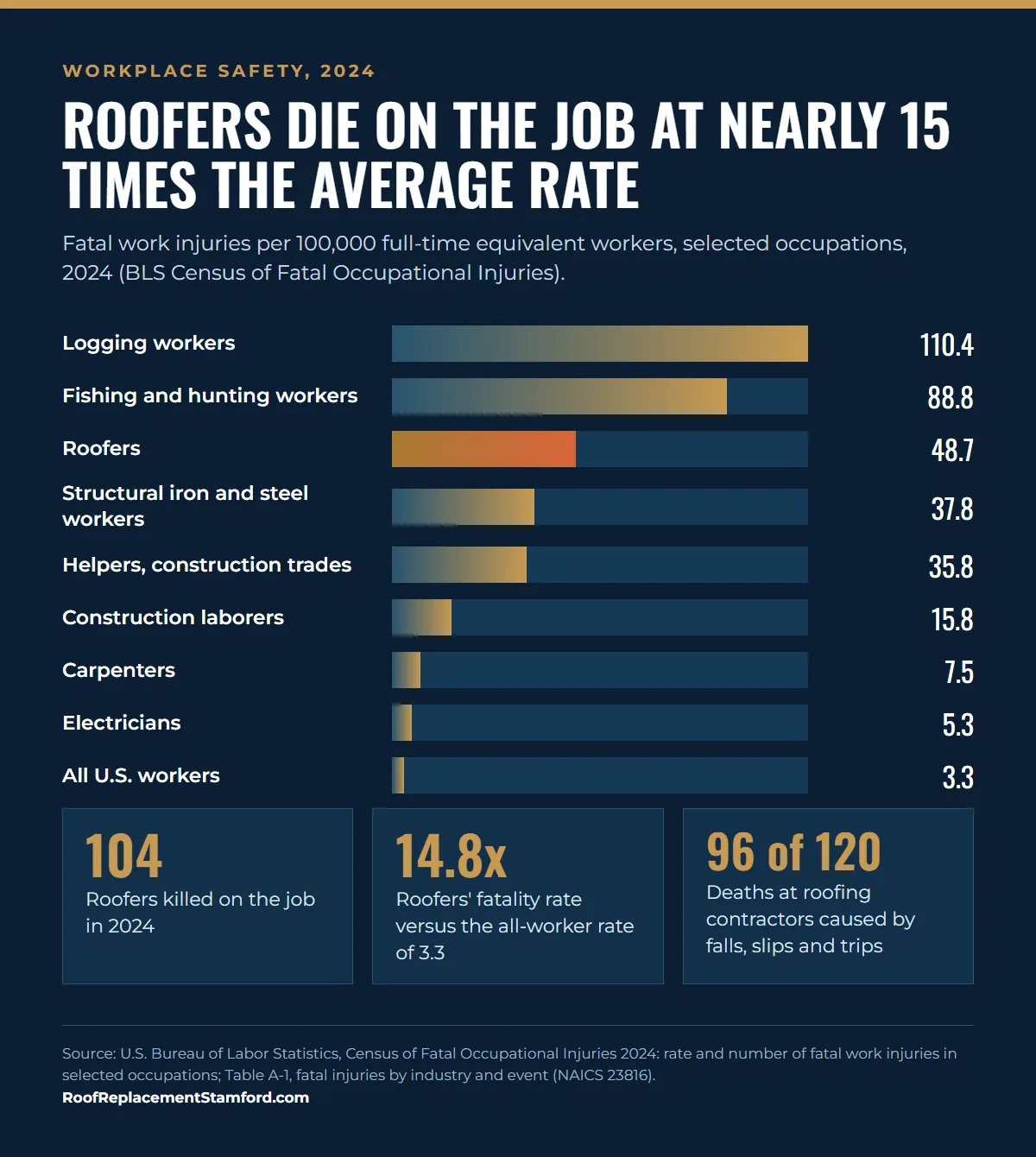
A roofer is more than six times as likely to die at work as a carpenter and nearly 15 times as likely as the average U.S. worker. That risk is priced into everything a legitimate roofing company pays for, from insurance to training and equipment.
6. Falls and Fall Protection
Most roofing deaths are falls. CFOI's industry tables count deaths at roofing contracting firms (NAICS 23816), which include roofers and anyone else those firms employ.
| Fatal injuries, 2024 | Value | Source |
|---|---|---|
| Deaths at roofing contractors | 120 | BLS CFOI Table A-1 |
| Of those, falls, slips and trips | 96 (80%) | BLS CFOI Table A-1 |
| Of those, exposure to harmful substances or environments | 13 | BLS CFOI Table A-1 |
| Of those, transportation incidents | 5 | BLS CFOI Table A-1 |
| All construction deaths / from falls, slips and trips | 1,034 / 389 | BLS CFOI Table A-1 |
| All U.S. deaths from falls, slips and trips | 844 | BLS CFOI |
| OSHA's most frequently cited standard, FY 2026 (preliminary) | Fall protection, 29 CFR 1926.501 | OSHA |
Source: BLS CFOI 2024, Table A-1, roofing contractors (NAICS 23816).
Federal rules require workers on residential roofs 6 feet or more above a lower level to be protected by guardrails, safety nets or personal fall arrest systems (29 CFR 1926.501). Fall protection was the top item on OSHA's preliminary fiscal 2026 list of most-cited standards, scaffolding was fourth, ladders fifth and fall protection training eighth. Harnesses, anchors, roof brackets and the time to set them up cost money, and they are one of the clearest differences between a properly run crew and a cut-rate one. If you see a crew working with no tie-offs, that tells you something about how the company runs.
7. Nonfatal Injury Rates at Roofing Contractors
The BLS Survey of Occupational Injuries and Illnesses (SOII) counts injuries that employers record. Roofing contractors' overall rate is close to the private-industry average, but their injuries are more serious: more of them keep workers off the job.
| Cases per 100 full-time workers, 2024 | Roofing contractors | All construction | Private industry | Source |
|---|---|---|---|---|
| Total recordable cases | 2.4 | 2.2 | 2.3 | BLS SOII Table 1 |
| Days away, restricted or transferred (DART) | 1.7 | 1.3 | 1.4 | BLS SOII Table 1 |
| Cases with days away from work | 1.1 | 0.9 | 0.8 | BLS SOII Table 1 |
SOII covers cases that employers record, so it does not include self-employed roofers. Lost-time injuries are what drive workers' compensation claims, and claims are what drive the premiums in the next section.
8. Connecticut Workers' Compensation Costs for Roofing
Connecticut workers' comp pricing starts from loss costs filed each year by the National Council on Compensation Insurance (NCCI) and approved by the Connecticut Insurance Department. Loss costs estimate expected claims per $100 of payroll for each job class; each insurer then adds its own expense factor. Roofing of all kinds is class 5551.
| Connecticut workers' comp, effective Jan. 1, 2026 | Per $100 of payroll | Source |
|---|---|---|
| Roofing (class 5551), voluntary market loss cost | $10.587 | NCCI filing via CT Insurance Dept. |
| Roofing (class 5551), assigned risk rate | $19.596 ($1,500 minimum premium) | NCCI filing via CT Insurance Dept. |
| Office clerical (class 8810), voluntary loss cost | $0.071 | NCCI filing via CT Insurance Dept. |
| Average statewide change approved for 2026 (voluntary / assigned risk) | -3.8% / -0.4% | CBIA |
| Average statewide change approved for 2027 (voluntary / assigned risk) | -4.9% / -5.8% | CT Insurance Department |
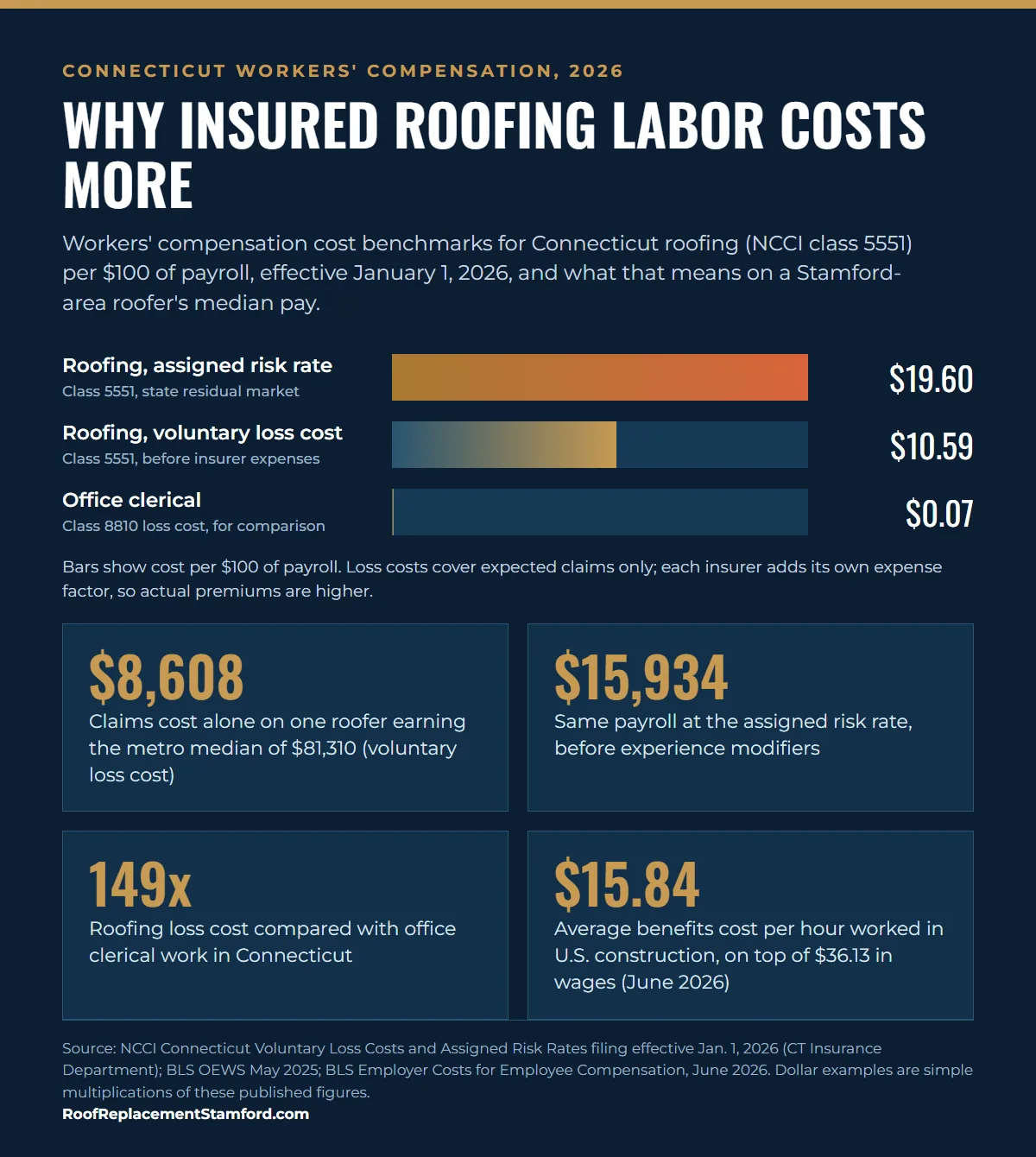
Roofing's loss cost is about 149 times the rate for office work and among the highest of any class in the Connecticut filing. Statewide loss costs have fallen for 22 straight years, according to the Insurance Department, but roofing remains one of the most expensive classes to insure. A contractor who skips coverage, or misclassifies roofers as some cheaper trade, can underbid an insured company by thousands of dollars on payroll alone. If an uninsured worker is hurt on your property, the cost has to land somewhere. Connecticut's Workers' Compensation Commission offers a free proof of coverage search so you can check a company before work starts.
9. Connecticut Registration Rules for Roofers
Connecticut has no separate state roofing license. Anyone who offers or does residential roofing work is a home improvement contractor under the Home Improvement Act and must register with the Department of Consumer Protection (DCP). Registration is a baseline, not an endorsement of quality: the law itself bars contractors from presenting it that way.
| Requirement | Detail | Source |
|---|---|---|
| DCP application fee | $220, nonrefundable | CT DCP |
| Statutory registration fee (part of the above) | $120 | Conn. Gen. Stat. Sec. 20-421 |
| Minimum general liability insurance | $20,000 | CT DCP |
| Guaranty Fund recovery for homeowners | Up to $25,000 | CT DCP |
| Registration number in every advertisement | Required | Conn. Gen. Stat. Sec. 20-427 |
| Offering or doing work without a registration | Class B misdemeanor | Conn. Gen. Stat. Sec. 20-427 |
| Written contract with registration number, start and completion dates and cancellation notice | Required, or not enforceable against the owner | Conn. Gen. Stat. Sec. 20-429 |
The Guaranty Fund is paid for by registered contractors' annual assessments. That fee, the liability policy, workers' comp and the paperwork a valid contract needs are all small costs that a legitimate roofing company carries and an unregistered one skips. You can check any contractor's registration on the state's eLicense lookup.
10. Legitimate Quotes vs. Storm-Chaser Quotes
After severe storms in July 2026, Connecticut's Attorney General and DCP Commissioner warned residents about door-to-door contractors offering roof repairs and cleanup. Their warning and the Home Improvement Act together give homeowners a practical checklist for comparing quotes.
| What to look for | Legitimate quote | Warning sign |
|---|---|---|
| Registration | DCP number on the contract and in ads | No number, or one that does not match on eLicense |
| Contract | Written, signed, with price, scope, start and end dates | Verbal deal or a one-line estimate |
| Timing | Time to compare quotes; 3-day cancellation notice | Pressure to sign or start today |
| Insurance | Liability and workers' comp certificates on request | Cannot or will not show coverage |
| Payment | Deposit and a payment schedule in the contract | Cash or full payment up front |
| Claims | Leaves coverage decisions to your insurer | Promises your insurance will pay for everything |
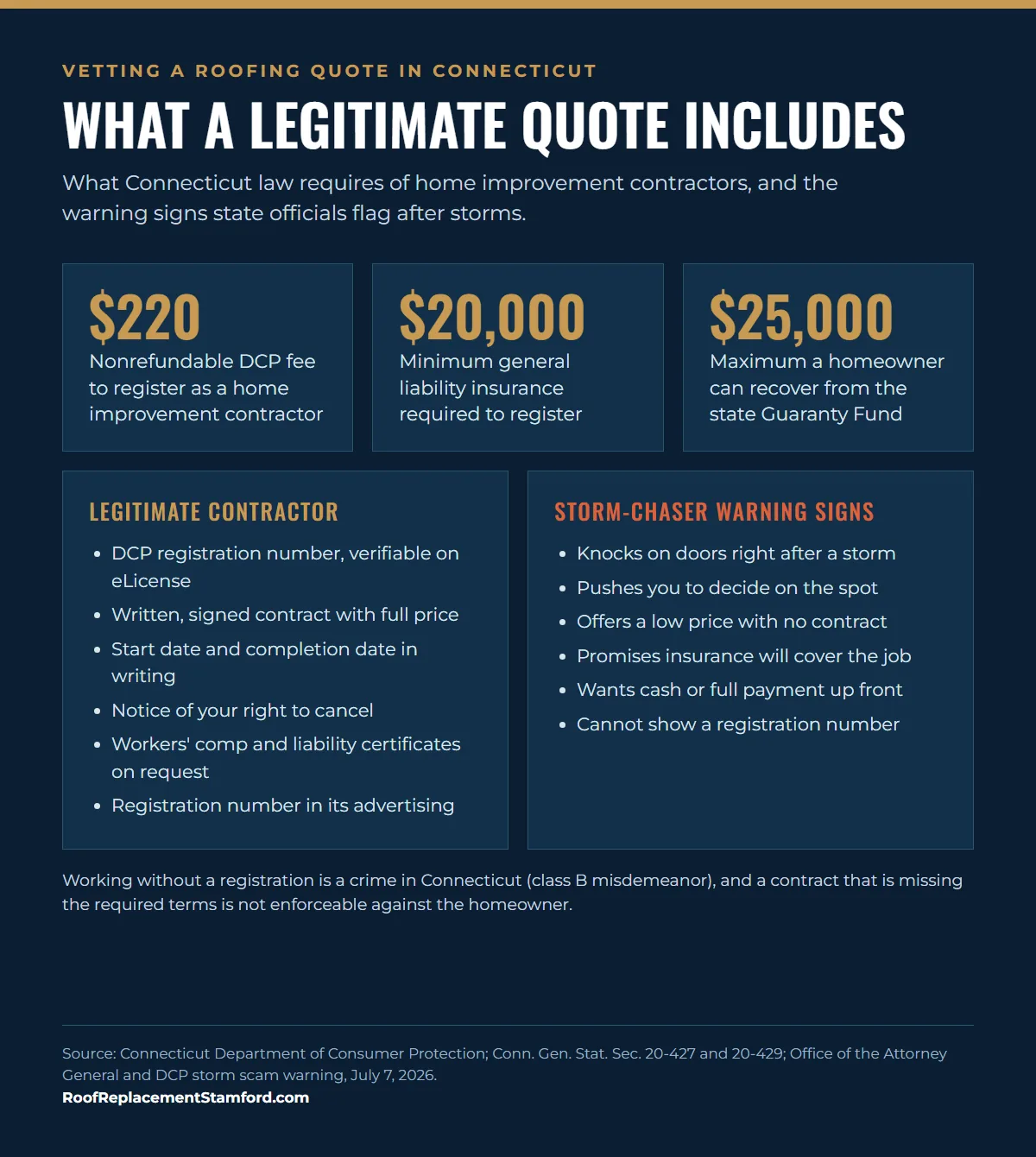
According to the Attorney General's July 2026 warning, unscrupulous contractors may offer low prices, skip the contract, promise that homeowner's insurance will cover the job and then do shoddy or incomplete work. A low quote is not proof of a bad contractor, but when one bid is far below the others, the data in this report suggests where the gap usually comes from: insurance, registration, safety equipment or wages. If your roof was damaged in a storm, our storm damage roof repair page explains what an inspection covers, and the roof insurance claims page covers documenting damage for your insurer.
11. Replacement vs. New Construction: Where Roofing Work Comes From
Most roofing work in the U.S. is not on new homes. The Freedonia Group's study of the U.S. residential roofing market found that new residential construction made up 21% of residential roofing demand in 2022, which leaves roughly 79% from work on existing homes, mainly reroofing. Freedonia also notes that the U.S. has a large number of roofs at or near the end of their expected life, making age-related reroofing the biggest driver of demand.
Source: The Freedonia Group, US Residential Roofing (2022 data).
Stamford's housing makes replacement even more dominant locally: as our Stamford housing stock and roof age report shows, most of the city's single-family homes were built before 1980. Replacement work means tearing off old layers, dealing with decking that may be decades old and working on occupied homes, all of which takes more labor and care than roofing a new frame. Our residential roof replacement page describes what a typical Stamford re-roof involves.
12. The Roofing Workforce
Roofing is a small trade nationally and a very small one in Fairfield County, and contractors report steady difficulty finding qualified workers.
| Workforce statistic | Value | Source |
|---|---|---|
| Roofer jobs in the U.S., 2025 (including self-employed) | 166,900 | BLS OOH |
| Share working for roofing contractors / self-employed | 72% / 20% | BLS OOH |
| Projected employment growth, 2025-2035 | +5% (faster than average) | BLS OOH |
| Projected openings per year | About 12,000 | BLS OOH |
| Roofers who are Hispanic or Latino (2025 annual average) | 64.7% | BLS CPS Table 11 |
| Roofers who are women (2025 annual average) | 0.9% | BLS CPS Table 11 |
| Payroll roofers in Connecticut / Bridgeport-Stamford-Danbury, May 2025 | 790 / 130 | BLS OEWS |
| Hiring construction firms reporting difficulty finding qualified workers, 2025 | 92% | AGC/NCCER survey via NRCA |
| Firms reporting project delays from worker shortages, 2025 | 45% | AGC/NCCER survey via NRCA |
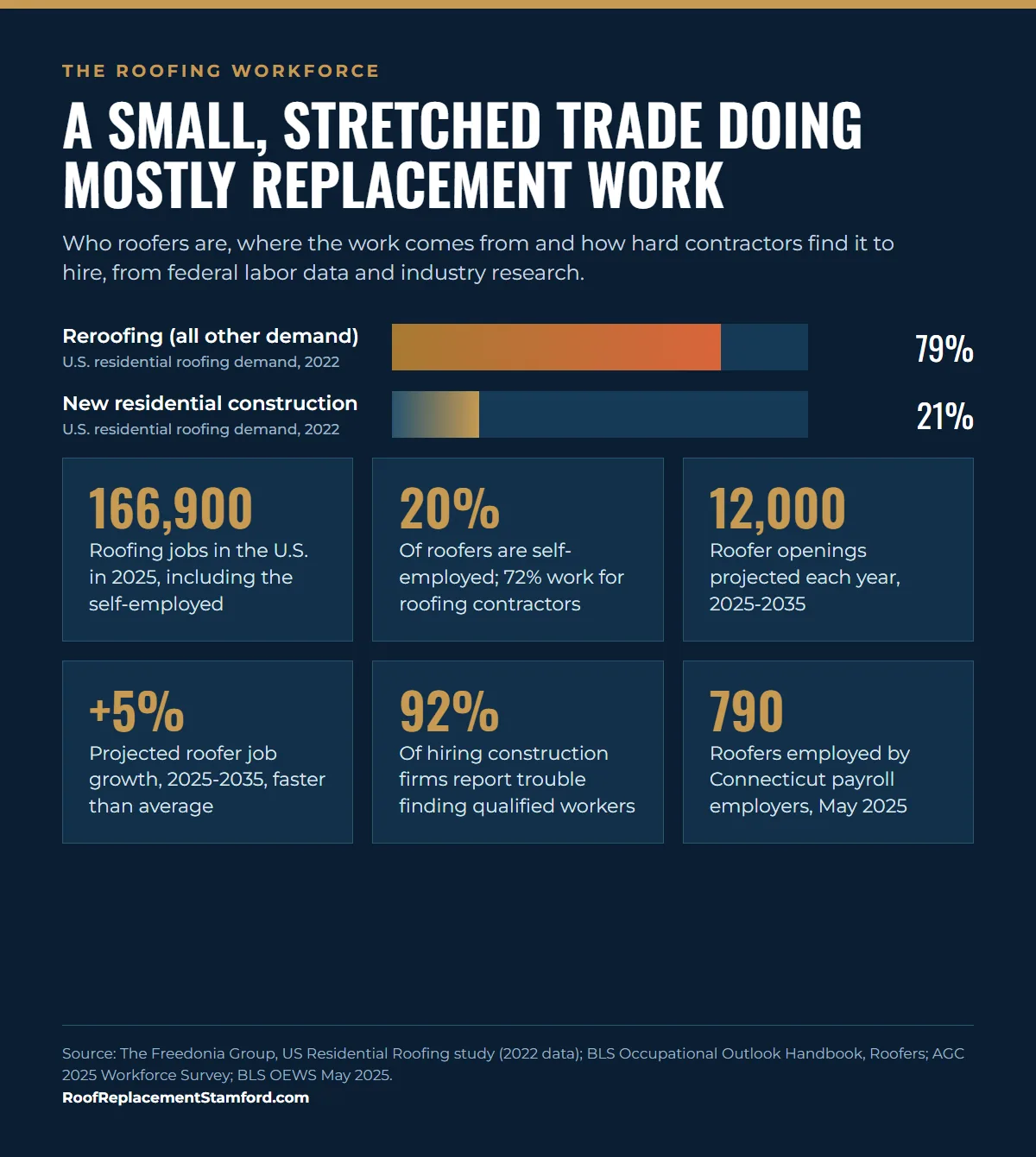
With roughly 130 payroll roofers in the metro, plus self-employed roofers the OEWS does not count, the pool of skilled roofing labor around Stamford is small. That small pool, the high local wage and the cost of keeping a crew insured and safe all feed into what a legitimate quote looks like. If you are weighing a quote for an older roof, our Stamford attic heat and cooling bill report covers ventilation and insulation questions worth raising at the same time.
13. Summary Table: Stamford Roofer Salary, Safety and Workforce Statistics
| Statistic | Value | Source |
|---|---|---|
| Median roofer wage, Bridgeport-Stamford-Danbury (May 2025) | $39.09/hr, $81,310/yr | BLS OEWS |
| Median roofer wage, Connecticut / U.S. | $62,070 / $55,440 | BLS OEWS |
| Metro roofer wage range, 10th-90th percentile | $49,950-$99,130 | BLS OEWS |
| Payroll roofers, metro / Connecticut / U.S. | 130 / 790 / 135,490 | BLS OEWS |
| Construction wages + benefits per hour (June 2026) | $36.13 + $15.84 | BLS ECEC |
| Roofer fatality rate / deaths, 2024 | 48.7 per 100,000 FTE / 104 | BLS CFOI |
| All-worker fatality rate, 2024 | 3.3 per 100,000 FTE | BLS CFOI |
| Deaths at roofing contractors from falls, 2024 | 96 of 120 | BLS CFOI |
| Roofing contractor days-away cases per 100 workers | 1.1 (private industry 0.8) | BLS SOII |
| OSHA's most cited standard, FY 2026 | Fall protection (1926.501) | OSHA |
| CT roofing workers' comp loss cost, 2026 | $10.587 per $100 payroll | NCCI / CT Insurance Dept. |
| CT roofing assigned risk rate, 2026 | $19.596 per $100 payroll | NCCI / CT Insurance Dept. |
| CT home improvement registration fee | $220 | CT DCP |
| Required liability insurance to register | $20,000 | CT DCP |
| Guaranty Fund maximum recovery | $25,000 | CT DCP |
| New construction share of U.S. residential roofing demand, 2022 | 21% | Freedonia Group |
| Projected roofer job growth, 2025-2035 | +5% | BLS OOH |
Methodology & Sources
This report was compiled in November 2026. Wage figures are from the BLS Occupational Employment and Wage Statistics May 2025 estimates for SOC 47-2181 (Roofers), retrieved through the BLS public data API; the Bridgeport-Stamford-Danbury, CT metropolitan area is BLS area 14860. OEWS counts payroll employees only, and metro estimates for small occupations rest on small samples. Safety figures are from the BLS Census of Fatal Occupational Injuries (2024) and Survey of Occupational Injuries and Illnesses (2024). Connecticut workers' compensation figures are taken from NCCI's voluntary loss cost and assigned risk rate filing effective January 1, 2026, as posted by the Connecticut Insurance Department; the dollar examples multiply those published rates by the BLS metro median wage and are illustrations, not premium quotes. We looked for a primary source for commonly quoted roofing labor billing rates of $40 to $90 an hour and for an 85% replacement share of roofing work and found none, so neither figure is used. This site connects callers with an independent local roofing contractor and does not set prices.
- BLS OEWS, Bridgeport-Stamford-Danbury, CT, May 2025
- BLS OEWS, Connecticut, May 2025
- BLS OEWS, Roofers (47-2181), national
- BLS OEWS, New York-Newark-Jersey City
- BLS OEWS, Boston-Cambridge-Newton
- BLS OEWS, Hartford metro
- BLS OEWS, New Haven metro
- BLS Occupational Outlook Handbook, Roofers
- BLS Employer Costs for Employee Compensation, June 2026
- BLS CFOI 2024, rates by occupation
- BLS CFOI 2024 news release
- BLS CFOI 2024, Table A-1
- BLS SOII 2024, Table 1
- BLS Current Population Survey, Table 11
- OSHA Top 10 Most Frequently Cited Standards
- OSHA 29 CFR 1926.501, Duty to have fall protection
- CT Insurance Department, NCCI 2026 filing
- CT Insurance Department, 2027 loss cost approval
- CBIA, 2026 workers' comp rates
- CT Workers' Compensation Commission, Coverage Verification
- CT DCP, Home Improvement Contractor Application
- CT DCP, Home Improvement Guaranty Fund
- Conn. Gen. Stat. Chapter 400, Home Improvement Act
- CT Attorney General and DCP storm scam warning, July 2026
- The Freedonia Group, US Residential Roofing
- NRCA, construction labor shortage survey, 2025
14. Frequently Asked Questions
How much do roofers make in Stamford, CT?
Roofers in the Bridgeport-Stamford-Danbury metro earned a median of $39.09 an hour, or $81,310 a year, in May 2025, according to the BLS Occupational Employment and Wage Statistics survey. The middle half earned between $55,890 and $98,540 a year. Self-employed roofers are not included.
What is the average roofer salary in Connecticut?
BLS reports a median roofer wage of $29.84 an hour ($62,070 a year) for Connecticut statewide in May 2025, and a mean of $32.93 an hour ($68,490 a year). About 790 roofers worked for payroll employers in the state. The national median was $55,440.
How dangerous is roofing?
Roofers had a fatal injury rate of 48.7 per 100,000 full-time workers in 2024, with 104 deaths, nearly 15 times the 3.3 rate for all U.S. workers, according to the BLS Census of Fatal Occupational Injuries. Falls, slips and trips caused 96 of the 120 deaths at roofing contracting firms that year.
How much does workers' comp cost for a roofing company in Connecticut?
NCCI's Connecticut filing effective January 1, 2026 sets a voluntary loss cost of $10.587 per $100 of payroll for roofing (class 5551) and an assigned risk rate of $19.596. Insurers add their own expenses to the loss cost, so actual premiums are higher. On one roofer paid the $81,310 metro median, the loss cost alone is about $8,608 a year.
Do roofers need a license in Connecticut?
Connecticut has no separate roofing license, but anyone doing residential roofing must register with the Department of Consumer Protection as a home improvement contractor. Registration costs $220, requires at least $20,000 of general liability insurance, and must be shown on contracts and in advertising. You can verify it on the state's eLicense website.
Why is one roofing quote so much cheaper than the others?
A legitimate roofing company pays local wages near $39 an hour, workers' comp of more than $10 per $100 of payroll, liability insurance, registration and safety equipment. A contractor who skips insurance or registration can bid lower. Connecticut officials warn that storm chasers may offer low prices without a contract, demand cash or promise insurance will pay. Check registration, insurance and a written contract before choosing.
Keep Reading
Comparing Roofing Quotes in Stamford?
Talk to an independent local roofing contractor about your roof and what a full replacement or repair should include. Check any contractor's DCP registration before work starts. Calls are connected 8 a.m. to 9 p.m.
Call +1 203-691-4756 More ways to reach us