Stamford Attic Ventilation, Heat Gain & Cooling Bill Savings Report (2026)
On a normal July afternoon Stamford tops out at 84.8°F. Field studies show the air in a poorly vented attic can run 27 to 36°F hotter than the air outside, and every extra kilowatt-hour your air conditioner spends fighting that heat is billed at some of the highest electricity prices in the country. This report pulls together the measured numbers on attic heat, cooling bills, shingle wear and winter ice dams for Stamford homeowners.
- Stamford's normal July high is 84.8°F, and the city averages 17.7 days a year at or above 90°F (NOAA 1991-2020 normals).
- Well-vented attics run 16-22°F above outdoor air on a design cooling day; poorly vented attics run 27-36°F above it (LBNL).
- In Florida tests, vented attics hit 122-142°F when it was 97°F outside, and peak shingle temperatures topped 180°F (LBNL).
- Air conditioning uses 14% of the electricity in Connecticut homes, about 1.5 billion kWh a year across 1.38 million households (EIA RECS).
- Connecticut's average residential price was 24.51¢/kWh in August 2026, down from 30.17¢ a year earlier but still far above the 18.16¢ U.S. average (EIA).
- Radiant barriers cut space cooling loads by roughly 6-20% across the research reviewed by ASHRAE (Medina, ASHRAE).
- Cool roofs can cut peak cooling demand in air-conditioned homes by 11-27% (EPA).
- Air sealing and adding insulation saves an average of 15% on heating and cooling costs (ENERGY STAR).
- Applied to the average Connecticut home's air-conditioning use, those percentages are worth roughly $16-$53 a year in cooling electricity at August 2026 prices: real, but modest.
- Venting an attic instead of sealing it changes average shingle temperature by only 2-3°F, about a 10% service-life effect; shingle color and roof orientation matter two to three times more (Building Science Corp.).
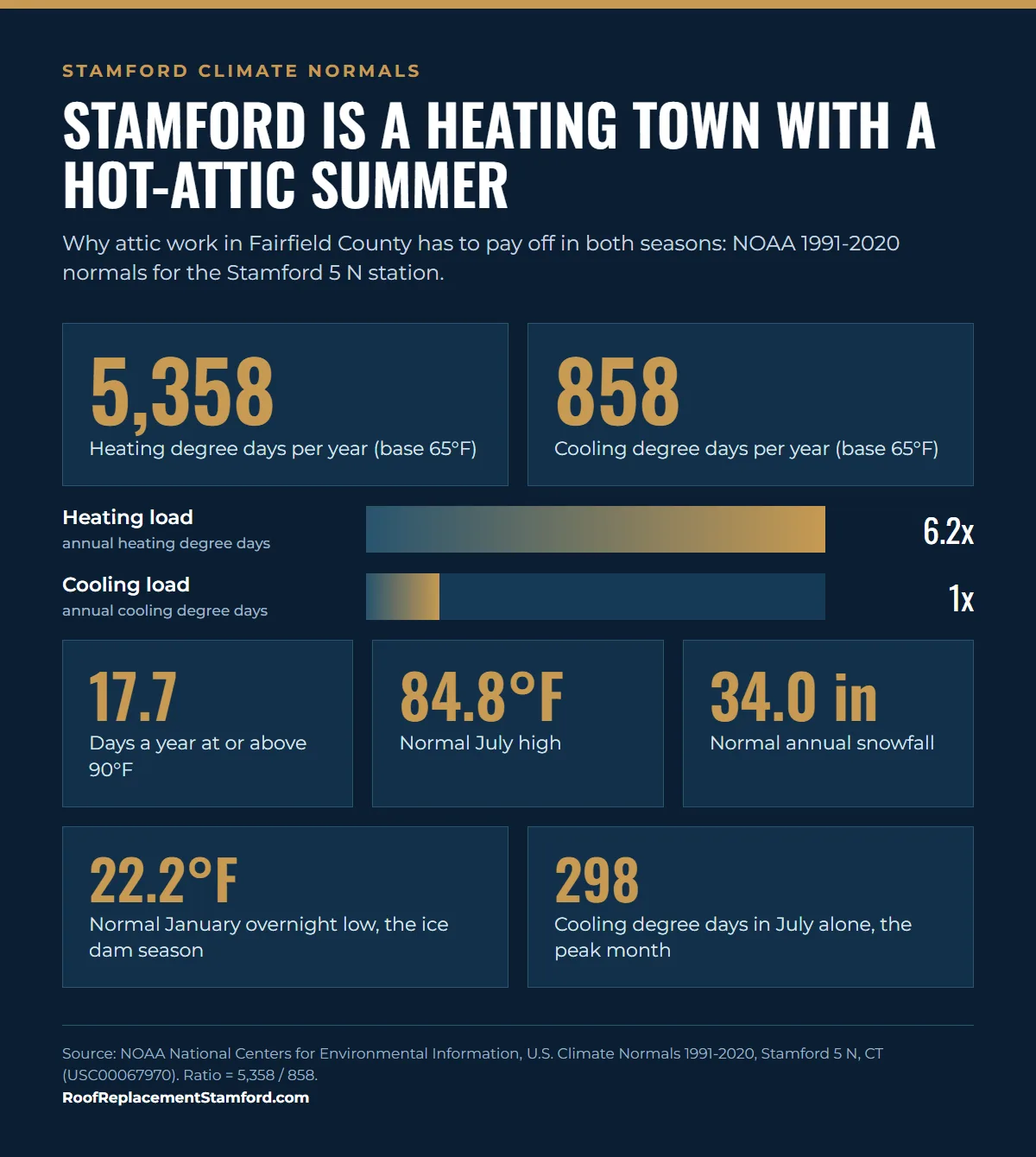
- Stamford logs 5,358 heating degree days against 858 cooling degree days and 34 inches of normal snowfall, so winter is where attic venting does its most important work (NOAA).
- Ice dams can form with as little as 2 inches of snow on a roof when warm house air leaks into the attic (PNNL).
- Energize CT pays up to $2.00 per square foot, or 75% of cost, for approved insulation after a Home Energy Solutions visit (Energize CT).
1. Stamford's Summer Heat by the Numbers
Stamford sits on Long Island Sound, and the water keeps its summers milder than inland Connecticut. NOAA's official 1991-2020 normals for the Stamford 5 N weather station put the average July high at 84.8°F, with August close behind. Hot spells are short but real: the station averages 17.7 days a year at 90°F or warmer, and most of them land in July.
| Metric (Stamford 5 N, 1991-2020 normals) | Value | Source |
|---|---|---|
| Normal July daily high | 84.8°F | NOAA NCEI |
| Normal August daily high | 82.9°F | NOAA NCEI |
| Normal June daily high | 79.8°F | NOAA NCEI |
| Days per year at or above 90°F | 17.7 | NOAA NCEI |
| Days at or above 90°F in July alone | 7.8 | NOAA NCEI |
| Cooling degree days per year (base 65°F) | 858 | NOAA NCEI |
| Cooling degree days in July | 298 | NOAA NCEI |
| Normal July high at Bridgeport Sikorsky Airport, for comparison | 83.4°F | NOAA NCEI |
Source: NOAA NCEI U.S. Climate Normals 1991-2020, station USC00067970 (Stamford 5 N).
Outdoor highs only tell half the story. The roof above your top floor sits in full sun for hours, and the attic under it collects that heat. The next section shows how far above the outdoor temperature attic air actually climbs.
2. How Hot Does an Attic Get in a Connecticut Summer?
Roofing websites often quote attic temperatures of 150°F or more. Measured data shows the answer depends heavily on venting and roof color, and the highest published attic readings come from hot-climate tests rather than Connecticut. A Lawrence Berkeley National Laboratory review of attic research summarizes field measurements from 24 Florida homes, two research homes in Alberta and a University of Illinois roof test facility. On a design cooling day, well-vented attics ran 16-22°F above outdoor air, while poorly vented attics ran 27-36°F above it.
| Measurement | Value | Source |
|---|---|---|
| Well-vented attic vs. outdoor air, cooling-season design day | +16 to 22°F | LBNL review (Walker 1998) |
| Poorly vented attic vs. outdoor air, cooling season | +27 to 36°F | LBNL review (Walker 1998) |
| Peak vented attic over peak outdoor air, white shingle roof | +28°F | LBNL review (Rose 1992) |
| Peak vented attic over peak outdoor air, dark shingle roof | +32°F | LBNL review (Rose 1992) |
| Vented attic peaks when it was 97°F outside (Florida test roofs) | 122 to 142°F | LBNL review (Parker & Sherwin 1998) |
| Dark-roofed attics on Florida summer afternoons | 130 to 140°F | Florida Solar Energy Center |
| Well-vented attic vs. outdoor air, heating season | +9 to 11°F | LBNL review (Walker 1998) |
| Poorly vented attic vs. outdoor air, heating season | +13°F | LBNL review (Walker 1998) |
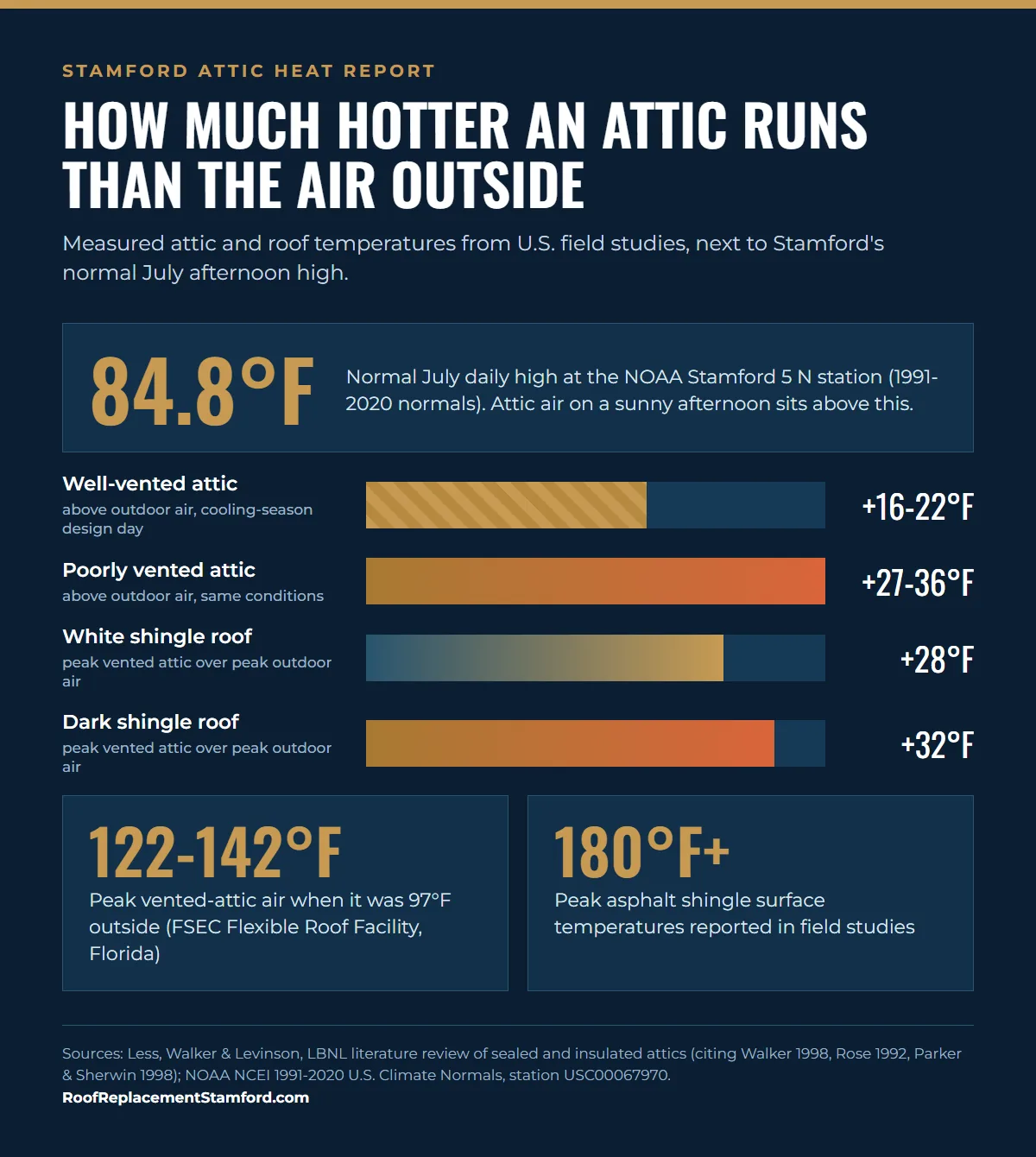
What this means for Stamford: you do not need Florida weather for an attic to bake. Because the gap between attic and outdoor air is driven by sun on the roof, a poorly vented attic over a dark roof can sit far above the day's high. If your upstairs bedrooms stay hot after sunset, an attic and roof inspection that checks intake vents, exhaust vents and insulation depth is the logical first step.
3. Roof and Shingle Surface Temperatures
The roof surface is where attic heat starts. Dark shingles absorb most of the sunlight that hits them, then pass that heat into the roof deck and the attic below. Research from Lawrence Berkeley National Laboratory and field tests compiled in its attic review show how hot the surface itself gets.
| Measurement | Value | Source |
|---|---|---|
| Traditional dark roofs in summer sun | 150°F or higher | LBNL Heat Island Group |
| How much cooler a cool surface can stay under the same sun | More than 50°F | LBNL Heat Island Group |
| Clean white roof (80% reflective) vs. grey roof (20% reflective) | About 50°F cooler | ENERGY STAR, citing LBNL |
| Peak asphalt shingle temperatures in field studies | Upwards of 180°F | LBNL review |
| Peak shingle temperature, sealed vs. vented attic (Fort Myers, FL) | 166°F vs. 144°F | LBNL review (Parker et al. 2002) |
| Typical shingle temperature difference, sealed minus vented attic | 3 to 7°F | LBNL review |
| Long-term average shingle difference, sealed minus vented | Less than 1°F | LBNL review |
| Peak roof sheathing temperature increase over sealed attics | 16 to 17°F | LBNL review |
For a Stamford homeowner planning a shingle roof replacement, these numbers point to two levers: shingle color, which sets how much heat the surface takes in, and ventilation, which controls how much of it lingers in the attic. Peak readings swing widely, but long-term averages differ far less than many sales pitches suggest.
4. How Connecticut Homes Use Air Conditioning
Attic heat only costs money if you pay to remove it. The U.S. Energy Information Administration's Residential Energy Consumption Survey (RECS) shows that 90% of Connecticut households use air conditioning, but most of them do it with window units or ductless mini-splits rather than central systems. That matters, because central systems with ducts in a hot attic lose the most to attic heat.
| Metric (Connecticut, 2020 RECS) | Value | Source |
|---|---|---|
| Occupied housing units | 1.38 million | EIA RECS |
| Households that use air-conditioning equipment | 90% (1.24 million) | EIA RECS |
| Households using central air conditioning | 34% | EIA RECS |
| Households using individual units (window, wall, portable, mini-split) | 60% | EIA RECS |
| Households using a dehumidifier | 32% | EIA RECS |
| Air conditioning's share of household electricity | 14% | EIA RECS CE4.1.EL.ST |
| Total household electricity used for air conditioning | 1.5 billion kWh per year | EIA RECS CE4.1.EL.ST |
| Space heating's share of household electricity | 11% | EIA RECS CE4.1.EL.ST |
| U.S. average: air conditioning's share of household electricity | 19% | EIA RECS CE4.1.EL.ST |
Source: EIA 2020 RECS. Some homes use both types, so the categories overlap; 10% of homes use no AC.
Divide the 1.5 billion kWh by 1.38 million homes and the average Connecticut household spends roughly 1,090 kWh a year on air conditioning. Homes with central air and ductwork in the attic sit above that average; homes with one or two window units sit well below it.
5. Stamford Electricity Prices
Stamford is in Eversource's Connecticut electric territory, so most homeowners here pay Eversource delivery charges plus either Eversource's standard service supply rate or a third-party supplier's rate. Connecticut's prices have moved sharply over the last two years.
| Metric | Value | Source |
|---|---|---|
| Connecticut average residential price, August 2026 | 24.51¢/kWh | EIA Table 5.6.A |
| Connecticut average residential price, August 2025 | 30.17¢/kWh | EIA Table 5.6.A |
| New England average residential price, August 2026 | 28.31¢/kWh | EIA Table 5.6.A |
| U.S. average residential price, August 2026 | 18.16¢/kWh | EIA Table 5.6.A |
| Average Connecticut residential bill, 2024 | $199.66/month at 695 kWh | EIA Table 5A |
| Average Connecticut residential price, 2024 | 28.75¢/kWh | EIA Table 5A |
| Average U.S. residential bill, 2024 | $144/month | EIA Today in Energy |
| Eversource Rate 1 standard service supply, July-Dec 2026 | 11.577¢/kWh | Energize CT Rate Board |
| Eversource Rate 7 peak supply (noon-8 p.m. weekdays), July-Dec 2026 | 14.129¢/kWh | Energize CT Rate Board |
| May 2026 PURA interim cut for an average Eversource home | 4.3¢/kWh, about $30/month | CT DEEP |
| July 2026 supply change, Eversource home using 700 kWh/month | About $7/month lower | CT Office of Consumer Counsel |
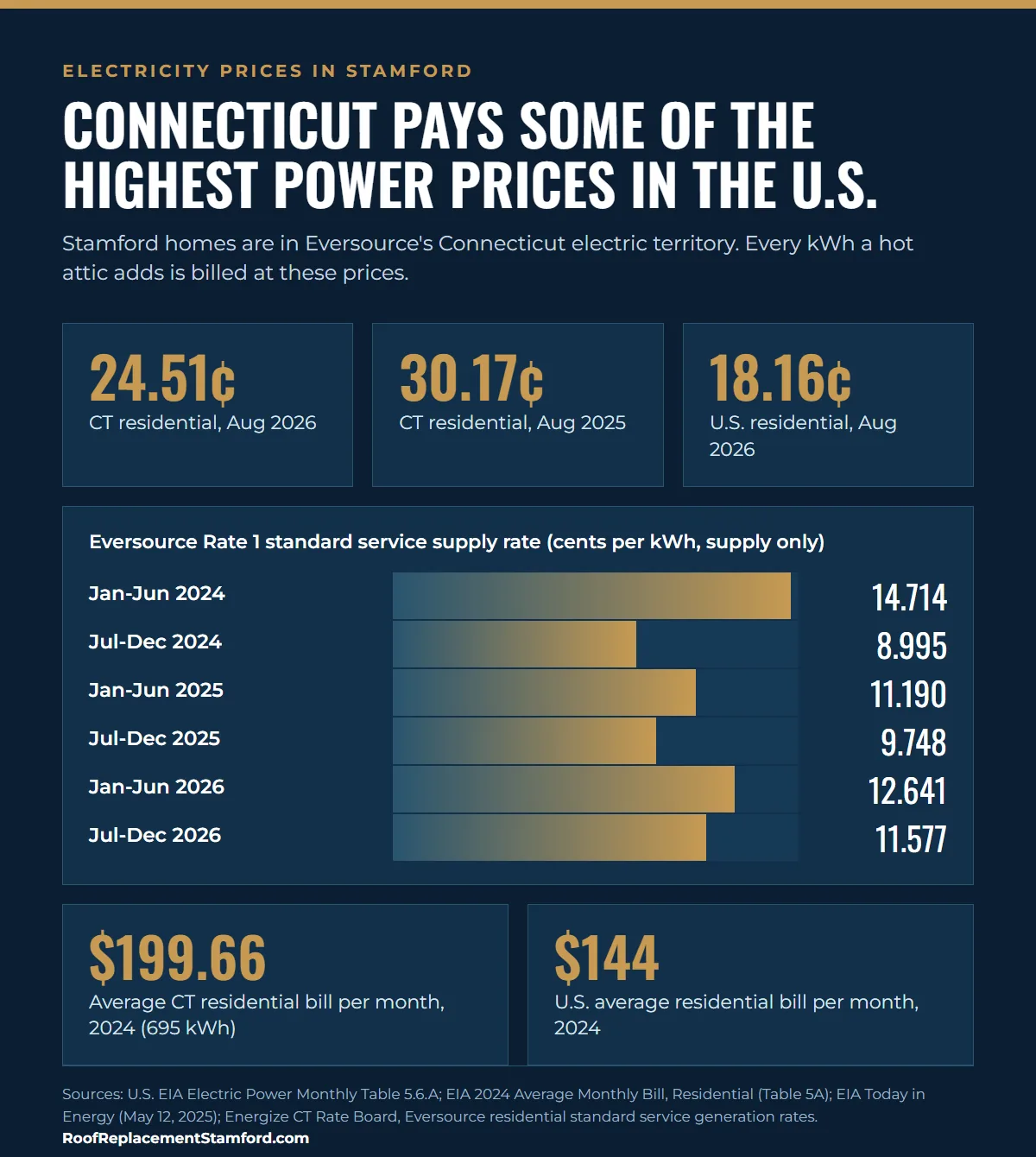
Note that supply is only part of the bill: Eversource also charges delivery and transmission per kWh. The EIA all-in average is the best single number for estimating what a saved kWh is worth, which is why the next sections use 24.51¢.
6. Measured Savings From Attic and Roof Upgrades
The research on attic upgrades is deep, but most of it was done in Florida, Texas and other hot climates where air conditioning runs for months. Treat these as upper-bound benchmarks for Stamford. The table separates cooling energy (kWh over a season) from peak demand (the highest load on the hottest afternoon), because they are not the same thing.
| Upgrade | Measured effect | Source |
|---|---|---|
| Radiant barrier, space cooling load (review of lab and field studies) | About 6-20% lower | Medina, ASHRAE review |
| Radiant barrier, summer ceiling heat flow | 23-45% lower | Medina, ASHRAE review |
| Radiant barrier, winter ceiling heat flow reduction | About 40% of the summer effect | Medina, ASHRAE review |
| Radiant barrier retrofit, 9 Florida homes, cooling energy | 9.3% lower (3.6 kWh/day) | Florida Solar Energy Center |
| Same retrofit, peak demand | 16% lower (420 W) | Florida Solar Energy Center |
| Same retrofit, average maximum daily attic temperature | 8.4°F lower | Florida Solar Energy Center |
| Reflective roof retrofits, 19 Florida homes, cooling energy | 19% lower on average | Florida Solar Energy Center |
| Reflective roof retrofits, peak demand | 23% lower on average | Florida Solar Energy Center |
| White shingle vs. dark shingle control roof, cooling energy | 4% lower (17% lower peak) | FSEC Flexible Roof Facility |
| White metal roof vs. dark shingle control roof, cooling energy | 23% lower | FSEC Flexible Roof Facility |
| Sealed (unvented) attic, space cooling | About 8% lower | FSEC field study |
| Cool roof, peak cooling demand in air-conditioned homes | 11-27% lower | U.S. EPA |
| Cool roof, maximum indoor temperature in homes without AC | 2.2-5.9°F lower | U.S. EPA |
| Air sealing plus attic, crawlspace and basement insulation | 15% lower heating and cooling costs (11% of total energy) | ENERGY STAR |
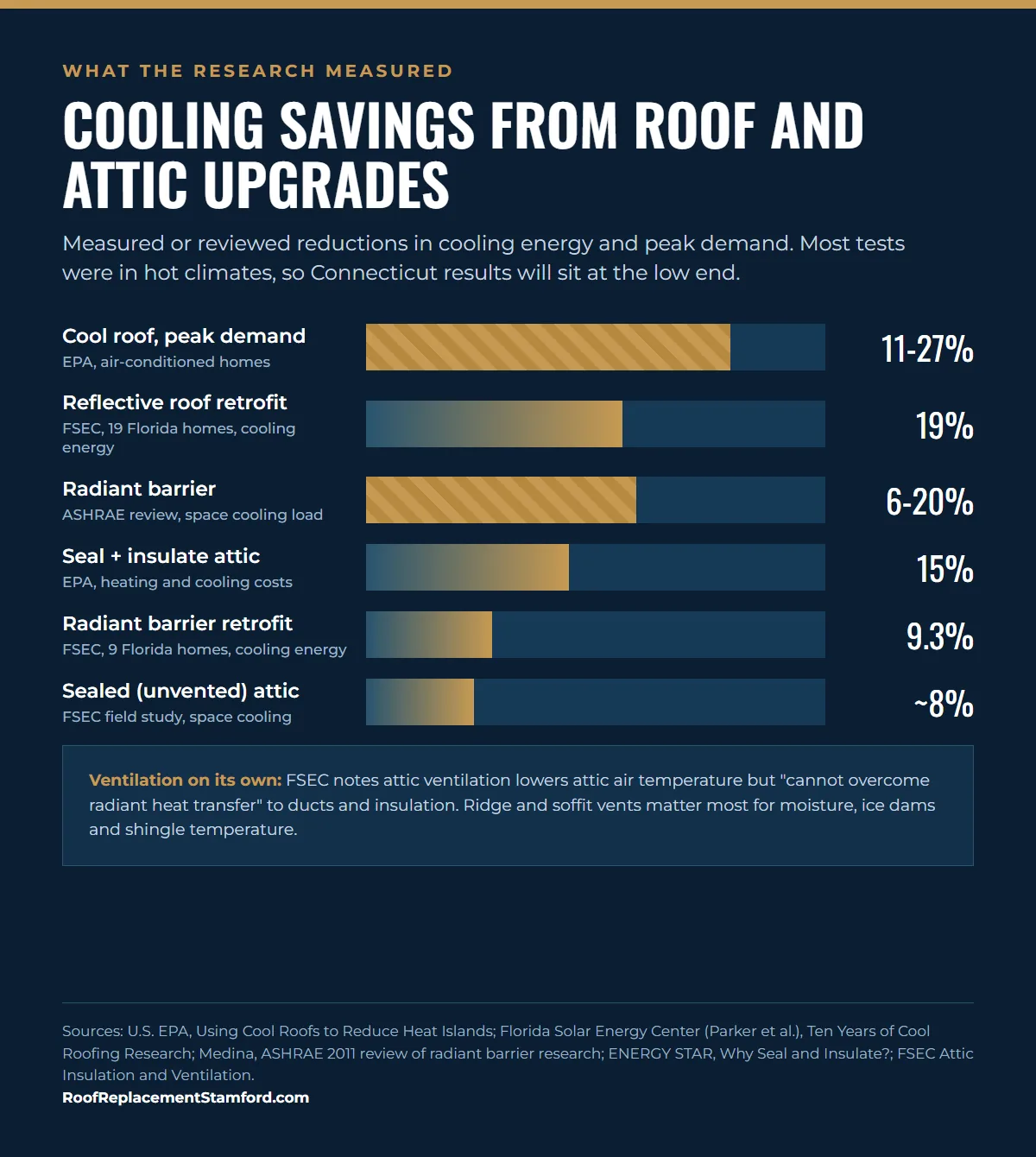
The pattern is consistent: the biggest cooling gains come from keeping solar heat out at the roof surface (reflective materials) or stopping it at the attic (radiant barriers, air sealing, insulation). Virginia Cooperative Extension notes that a radiant barrier over an attic already insulated to R-30 or more saves much less than one over a thinly insulated attic, which describes many Connecticut retrofits.
7. What the Savings Are Worth on a Connecticut Bill
To tie the research to a real bill, the table below applies each measured percentage to the average Connecticut household's air-conditioning use (about 1,090 kWh a year, from EIA RECS) at the August 2026 statewide residential price of 24.51¢/kWh. This is illustrative arithmetic on published averages, not a quote or a measured Stamford result.
| Benchmark applied | Savings % | kWh saved per year | Dollars per year at 24.51¢ |
|---|---|---|---|
| Radiant barrier, low end of ASHRAE review | 6% | 65 kWh | $16 |
| Sealed attic, FSEC field study | 8% | 87 kWh | $21 |
| Radiant barrier retrofit, FSEC 9 homes | 9.3% | 101 kWh | $25 |
| Air seal + insulate, EPA average | 15% | 163 kWh | $40 |
| Reflective roof retrofit, FSEC 19 homes | 19% | 207 kWh | $51 |
| Radiant barrier, high end of ASHRAE review | 20% | 217 kWh | $53 |
Inputs: EIA 2020 RECS (1.5 billion kWh for AC across 1.38 million CT homes); EIA Electric Power Monthly Table 5.6.A (24.51¢/kWh, August 2026). Savings percentages from the sources in Section 6.
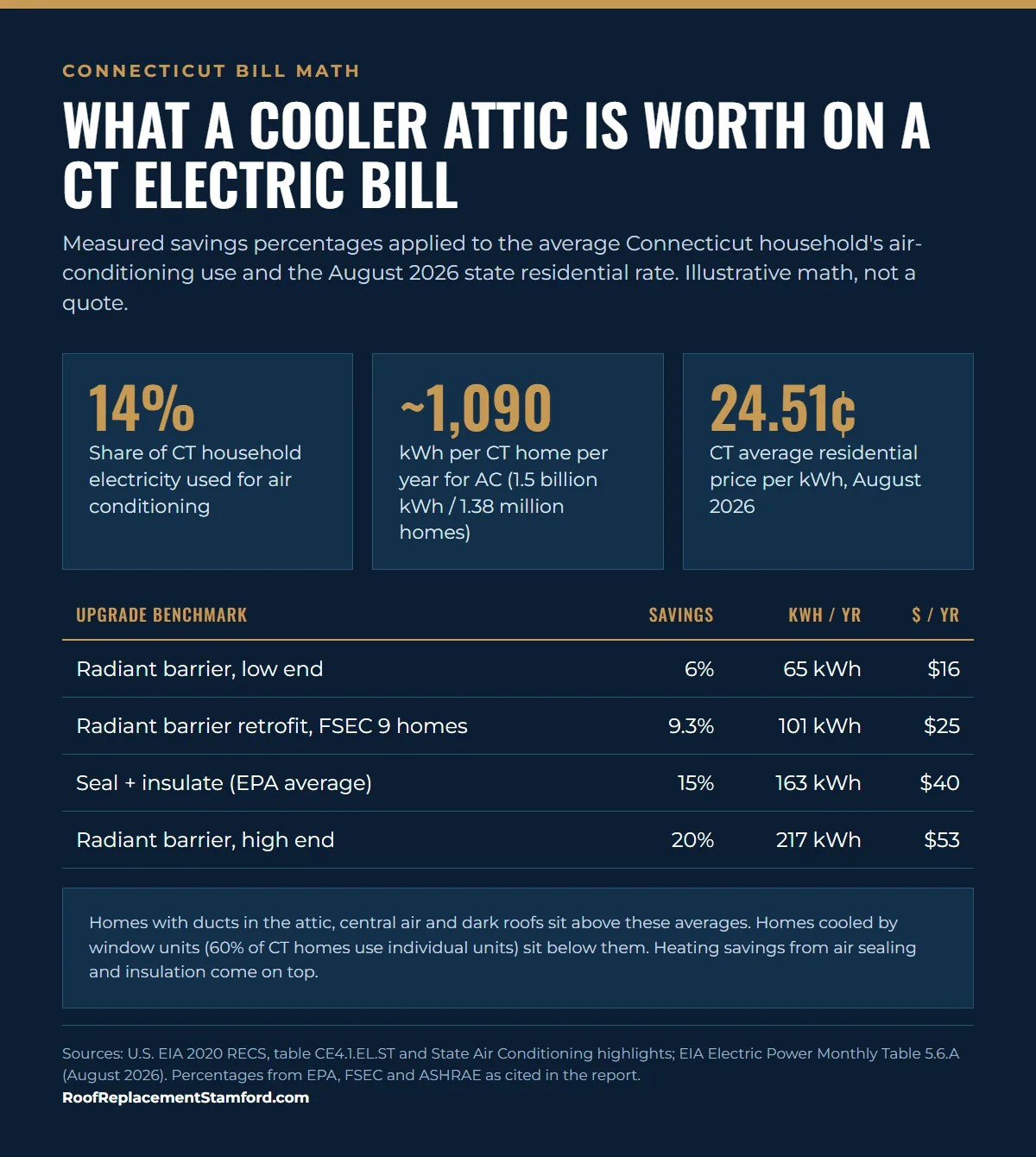
The honest takeaway for Stamford: cooling savings alone rarely justify a new roof. They are a bonus on top of the bigger reasons to fix an attic here, which are heating losses, ice dams, moisture and shingle life. Air sealing and insulation are the exception, because ENERGY STAR's 15% figure covers heating as well as cooling, and heating is the larger bill in Connecticut.
8. Do Ridge Vents Lower Electric Bills?
Ridge vents paired with soffit intake are the standard way to vent a shingle roof, and they do lower attic air temperature. Whether that shows up on the electric bill depends on what sits in the attic. The Florida Solar Energy Center states that ventilation lowers attic air temperature but "cannot overcome radiant heat transfer" to ducts and the top of the insulation. Building Science Corporation adds that in cold climates the main job of attic ventilation is to keep the roof cold and carry away moisture, not to cool the house.
| Finding | Value | Source |
|---|---|---|
| Supply duct and air handler leakage in attic systems | Can exceed 20% of system flow | Building Science Corp. BSD-102 |
| Energy penalty from that leakage | About 20% of the total space conditioning load | Building Science Corp. BSD-102 |
| Annual cost of poorly sealed ducts leaking into an attic | $100-$300 per year (ORNL simulations) | Oak Ridge National Laboratory |
| Spray-foam attic sealing cost vs. annual savings (ORNL example) | About $8,000 to save upward of $460/yr | Oak Ridge National Laboratory |
| Powered attic fans vs. natural ventilation | Similar attic heat-flow reduction; fans can pull air from the house | FSEC |
| Vent balance recommended by FSEC | Equal open area for inlets and exits | FSEC |
So, do ridge vents lower electric bills? Modestly, and mostly in homes with ducts or air handlers in the attic. Their bigger payoff in Stamford is protecting the roof: a balanced ridge-and-soffit system is what manufacturers expect, it cuts winter moisture, and it reduces ice dam risk. If you have exhaust vents but blocked or missing soffit intake, our flashing and vent repair page explains what a contractor checks.
9. Attic Heat, Shingle Blistering and Roof Life
Overheated attics are often blamed for blistered shingles and early granule loss. The measured temperature effect of venting on shingles is real but smaller than many claims. Building Science Corporation, citing field research, reports that shingles over unvented attics typically run only 2-3°F hotter on average, with the roof sheathing about 10°F hotter. Using the Arrhenius equation, that works out to about a 10% reduction in shingle service life, and shingle color and roof orientation have two to three times more effect than venting.
| Finding | Value | Source |
|---|---|---|
| Average shingle temperature rise over unvented vs. vented attics | 2-3°F | Building Science Corp. BSD-102 |
| Average roof sheathing temperature rise, unvented | About 10°F | Building Science Corp. BSD-102 |
| Expected shingle service-life reduction from that rise | About 10% | Building Science Corp. BSD-102 |
| Effect of shingle color and orientation vs. venting choice | 2-3 times larger | Building Science Corp. BSD-102 |
| Shingle life reduction roofing contractors report seeing from poor or no ventilation (industry poll) | 24% | Roofing Contractor |
| Manufacturer ventilation guideline (soffit to ridge) | 1 sq ft net free area per 300 sq ft of attic | GAF TAB-R-120 |
| Cool roofs and roof material life | Lower roof temperature slows material degradation | ENERGY STAR |
We could not find a primary study that puts a number on blistering or granule loss caused by attic heat alone, so this report does not give one. What the data does support: attic heat speeds aging somewhat, dark south- and west-facing slopes age fastest, and a roof replacement is the cheapest moment to fix intake and exhaust venting, because the roof deck and ridge are already open.
10. Winter: Ice Dams and Attic Moisture
Stamford is a heating-dominated climate. NOAA's normals show 5,358 heating degree days a year against 858 cooling degree days, a ratio of about 6.2 to 1, along with 34 inches of normal snowfall. That makes winter the season where attic ventilation and air sealing do their most valuable work. Building Science Corporation puts it plainly: in cold climates the primary purpose of attic ventilation is to keep the roof cold to control ice dams and to vent moisture that moves up from the house.
| Metric | Value | Source |
|---|---|---|
| Heating degree days per year, Stamford 5 N | 5,358 | NOAA NCEI |
| Normal annual snowfall, Stamford 5 N | 34.0 inches | NOAA NCEI |
| Snowiest month (February normal) | 11.9 inches | NOAA NCEI |
| Normal January low / high | 22.2°F / 38.0°F | NOAA NCEI |
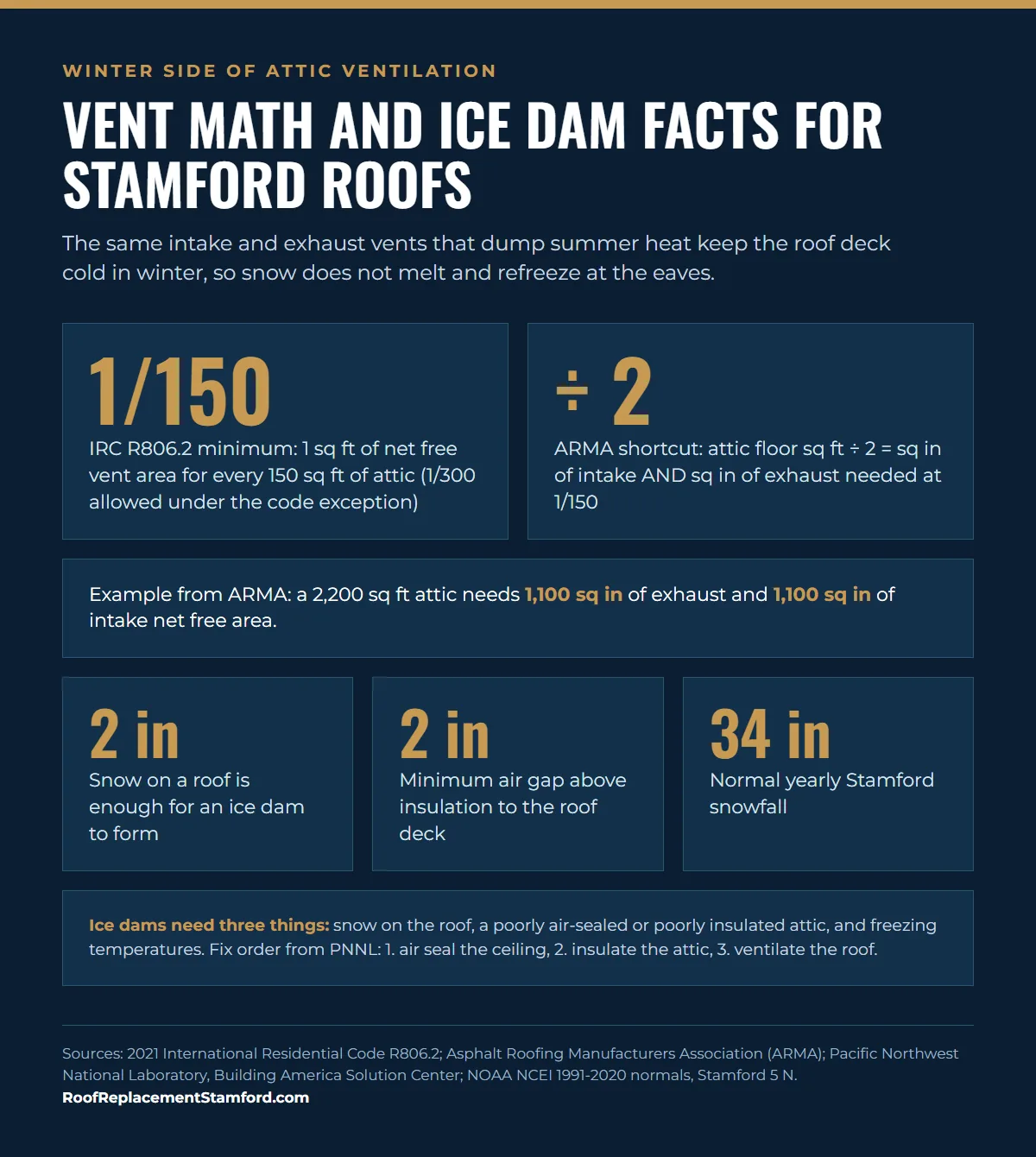
| Snow depth that can be enough for an ice dam | As little as 2 inches | PNNL Building America Solution Center |
| Conditions needed for an ice dam | 3: snow on the roof, a leaky or under-insulated attic, freezing temperatures | PNNL |
| Minimum air gap between insulation and roof deck at the eaves | 2 inches | PNNL |
| Ceiling insulation vs. typical attic duct insulation | Above R-30 vs. about R-6 | Building Science Corp. BSD-102 |
PNNL's fix order is clear: air seal the ceiling first, insulate the attic second, ventilate the roof third. Venting alone will not stop ice dams if warm air is pouring through recessed lights and attic hatches. Our winter roof prep guide covers the Connecticut code's ice barrier requirement, and the roof maintenance page covers the fall checks that catch blocked soffit vents.
11. How Much Ventilation a Roof Needs
Ventilation is sized by net free area (NFA): the open area air can actually pass through. The International Residential Code, which Connecticut's building code is based on, sets the minimum, and the Asphalt Roofing Manufacturers Association (ARMA) publishes a quick way to check it.
| Rule | Value | Source |
|---|---|---|
| IRC R806.2 minimum net free ventilating area | 1/150 of the vented attic area | ICC, 2021 IRC |
| IRC exception (when its conditions are met) | 1/300 | ICC, 2021 IRC |
| Most common ratio across building codes | 1:300 | Building Science Corp. BSD-102 |
| ARMA shortcut at 1/150 | Attic sq ft ÷ 2 = sq in of intake and of exhaust | ARMA |
| ARMA shortcut at 1/300 | Attic sq ft ÷ 4 | ARMA |
| ARMA worked example, 2,200 sq ft attic | 1,100 sq in exhaust + 1,100 sq in intake | ARMA |
| If intake and exhaust cannot be balanced | Favor more intake than exhaust | ARMA |
ARMA notes that missing intake is the leading cause of venting callbacks. Many older Stamford capes and colonials have ridge vents but painted-over or insulation-stuffed soffits. A contractor sizing a new roof should show you the NFA math for both intake and exhaust, which is a good reason to ask about it during a roof inspection before any shingle replacement.
12. Insulation Targets and Connecticut Rebates
Because air sealing and insulation pay off in both seasons, they are usually the best-value attic upgrade in Connecticut. The state's Energize CT program, funded through Eversource and the other utilities, helps cover the cost.
| Metric | Value | Source |
|---|---|---|
| Average heating and cooling savings from sealing and insulating | 15% | ENERGY STAR |
| Average total energy savings from the same work | 11% | ENERGY STAR |
| U.S. homes that are under-insulated | 9 out of 10 | ENERGY STAR |
| Energize CT insulation rebate, contractor installed | Up to $2.00/sq ft or 75% of cost, whichever is less | Energize CT |
| Energize CT rebate in Environmental Justice communities | $2.50/sq ft, up to $15,000 | Energize CT |
| Energize CT rebate, self-installed | $0.25/sq ft | Energize CT |
| Attic floor eligibility: existing / required final R-value | R-19 or less / R-49 or more (R-38 where R-49 is not practical) | Energize CT |
| Income-eligible households (below 60% of state median income) | Up to 100% of insulation costs | Energize CT |
The practical sequence for a Stamford home with a hot upstairs and high bills: book an Energize CT Home Energy Solutions visit, air seal and insulate the attic floor, then fix intake and exhaust venting. If the roof is near the end of its life, do the venting as part of the roof replacement and consider a lighter shingle color on sun-facing slopes.
13. Summary Table: Stamford Attic and Cooling Statistics
| Statistic | Value | Source |
|---|---|---|
| Normal July high, Stamford | 84.8°F | NOAA NCEI |
| Days per year at or above 90°F | 17.7 | NOAA NCEI |
| Heating vs. cooling degree days | 5,358 vs. 858 | NOAA NCEI |
| Normal annual snowfall | 34.0 in | NOAA NCEI |
| Well-vented attic above outdoor air (design day) | +16-22°F | LBNL review |
| Poorly vented attic above outdoor air | +27-36°F | LBNL review |
| Vented attic peaks at 97°F outdoor (Florida) | 122-142°F | LBNL review |
| Peak shingle temperatures | 180°F+ | LBNL review |
| Dark roof surface in summer sun | 150°F+ | LBNL Heat Island Group |
| CT homes using AC / central AC | 90% / 34% | EIA RECS |
| AC share of CT household electricity | 14% | EIA RECS |
| CT residential price, Aug 2026 | 24.51¢/kWh | EIA |
| CT average monthly bill, 2024 | $199.66 | EIA |
| Eversource Rate 1 supply, Jul-Dec 2026 | 11.577¢/kWh | Energize CT |
| Radiant barrier cooling load reduction | 6-20% | ASHRAE review |
| Reflective roof retrofit cooling savings (Florida) | 19% | FSEC |
| Cool roof peak cooling demand cut | 11-27% | EPA |
| Seal + insulate heating and cooling savings | 15% | ENERGY STAR |
| Illustrative annual cooling savings, average CT home | $16-$53 | Calculated from EIA data |
| Shingle life effect of unvented attic | ~10% | Building Science Corp. |
| IRC minimum attic vent area | 1/150 (1/300 exception) | ICC |
| Snow needed for an ice dam | 2 in | PNNL |
| Energize CT insulation rebate | Up to $2.00/sq ft or 75% | Energize CT |
Methodology & Sources
This report was compiled in November 2026 from government data, national laboratory research, building science publications and Connecticut utility and regulator documents. Stamford climate figures use NOAA's 1991-2020 normals for the Stamford 5 N station (USC00067970). Electricity prices use the most recent EIA monthly data available (August 2026). Most attic temperature and savings research comes from hot-climate test sites; we say so where it applies. Dollar figures in Section 7 are arithmetic on published averages, not measurements. Where a commonly repeated claim could not be traced to a primary source (for example, specific attic temperature ranges for Connecticut, or blistering rates caused by attic heat), we left it out.
- NOAA NCEI, U.S. Climate Normals 1991-2020
- LBNL, Literature Review of Sealed and Insulated Attics
- LBNL Heat Island Group, Keep Your Cool
- FSEC, Ten Years of Cool Roofing Research (Parker, 2005)
- FSEC, Attic Insulation and Ventilation
- Medina, Review of Radiant Barrier Research (ASHRAE)
- U.S. EPA, Using Cool Roofs to Reduce Heat Islands
- ENERGY STAR, Cool Roofs
- ENERGY STAR, Why Seal and Insulate?
- EIA, 2020 RECS State Air Conditioning
- EIA, 2020 RECS Table CE4.1.EL.ST
- EIA, Electric Power Monthly Table 5.6.A
- EIA, 2024 Average Monthly Bill, Residential
- EIA, Today in Energy (May 12, 2025)
- Energize CT, Residential Standard Service Rate Board
- Energize CT, Insulation Incentive Details
- Eversource, Communities We Serve
- CT DEEP, April 22, 2026 rate announcement
- CT Office of Consumer Counsel, July 2026 advisory
- Building Science Corp., BSD-102
- PNNL, Ice Dam Prevention guide
- Oak Ridge National Laboratory news release
- ICC, 2021 IRC Section R806.2
- ARMA, The Attic Needs Ventilation
- GAF, TAB-R-120 Proper Attic Ventilation
- Roofing Contractor, Impact of Attic Ventilation on Shingle Life
- Virginia Cooperative Extension, What about Radiant Barriers?
14. Frequently Asked Questions
How hot does an attic get in a Connecticut summer?
There is no published Connecticut-specific attic survey, but field research summarized by Lawrence Berkeley National Laboratory found well-vented attics running 16-22°F above outdoor air on a design cooling day and poorly vented attics running 27-36°F above it. With Stamford's normal July high at 84.8°F, a typical attic is past 100°F on a sunny afternoon and a poorly vented one can be much hotter.
Do ridge vents lower electric bills?
Somewhat, mainly in homes with central air ducts or an air handler in the attic. The Florida Solar Energy Center notes that ventilation lowers attic air temperature but cannot overcome radiant heat transfer, so radiant barriers, reflective roofing, air sealing and insulation usually save more. In Connecticut, the bigger benefits of balanced ridge and soffit venting are ice dam control, moisture control and roof life.
How much can a cool roof save on energy in Connecticut?
EPA reports that cool roofs can cut peak cooling demand in air-conditioned homes by 11-27%, and Florida field tests measured 19% average cooling savings from reflective roof retrofits. Connecticut savings will be lower because the cooling season is short; ENERGY STAR notes cool roofs save the most in hot, sunny climates. Applied to the average Connecticut home's air-conditioning use, published savings rates work out to roughly $16-$53 a year.
Is a radiant barrier worth it in Stamford?
Research reviewed for ASHRAE shows radiant barriers cut space cooling loads by about 6-20%, with the smallest gains in attics that are already well insulated. Stamford's long heating season and Connecticut's R-49 insulation target mean most homeowners get more from air sealing and insulation first, then a radiant barrier if ducts run through the attic.
Does poor attic ventilation cause ice dams?
It contributes. PNNL lists three conditions for ice dams: snow on the roof, a poorly air-sealed or poorly insulated attic, and freezing temperatures. Ventilation keeps the roof deck cold, but air sealing the ceiling is the most important step. Ice dams can form with as little as 2 inches of snow.
How much attic ventilation does my roof need?
The 2021 IRC requires 1 square foot of net free vent area per 150 square feet of attic, or 1 per 300 under its exception. ARMA's shortcut: divide attic floor square footage by 2 to get the square inches of intake and of exhaust needed at 1/150. A 2,200 square foot attic needs about 1,100 square inches of each.
Who is the electric utility in Stamford, CT?
Stamford is in Eversource's Connecticut electric service territory. Eversource's Rate 1 standard service supply rate is 11.577¢ per kWh for July-December 2026, and the statewide average all-in residential price was 24.51¢ per kWh in August 2026, according to the EIA.
Keep Reading
Upstairs Too Hot or Ice Dams Every Winter?
Talk to an independent local roofing contractor about attic venting, insulation and whether your roof is due for replacement. Calls are connected 8 a.m. to 9 p.m.
Call +1 203-691-4756 More ways to reach us