Stamford Housing Stock & Aging Roof Replacement Wave Report (2026)
The typical Stamford home was built in 1973, and nearly half of the city's occupied single-family houses went up before 1960. Most asphalt shingle roofs last about 20 to 30 years, and Connecticut insurers commonly cap shingle roof eligibility at 15 to 20 years. This report maps when and where Stamford's homes were built, which neighborhoods hold the oldest roofs, and what a new roof is worth when you sell.
- Stamford has 58,655 housing units, and the median one was built in 1973, six years newer than Connecticut's median (1967) but seven years older than the U.S. median (1980) (Census ACS 2020-2024).
- 32.6% of all Stamford housing units and 46.7% of its occupied single-family homes were built before 1960 (Census ACS B25034, B25127).
- 73.8% of Stamford's occupied single-family homes are more than 45 years old (built before 1980) (Census ACS B25127).
- 4,350 Stamford homes were built in 2000-2009, so any original roofs on them are now 17 to 26 years old (Census ACS).
- Most of the South End Historic District's 449 buildings date from 1870 to 1930 (NRHP nomination).
- Revonah Manor, Stamford's first planned neighborhood, was laid out in 1909, and 39 of its 50 homes were built by 1935 (NRHP nomination).
- Asphalt shingle roofs last about 20 years (3-tab) to 30 years (architectural); slate lasts about 100 (InterNACHI).
- Connecticut insurers commonly set asphalt roof eligibility limits of 15 to 20 years; architectural shingles often qualify for 25 years or more (CT Insurance Department).
- 18% of residential roofs in the Northeast are 31 years or older, the highest share of any U.S. region; only 4% are in the South (Verisk).
- The average U.S. residential roof replacement claim reached $17,631 in 2025, about 33% above the 2021-2024 average (Verisk).
- A new asphalt shingle roof recoups 67.5% of its cost at resale nationally and 62.6% in New England (2025 Cost vs. Value Report).
- NAR's 2022 Remodeling Impact Report put new roofing at 100% cost recovered, the top exterior project (NAR).
- 37% of Realtors recommend that sellers put on a new roof before listing (NAR 2025).
- Stamford's design ground snow load is 30 pounds per square foot under the 2022 Connecticut State Building Code (CT Residential Code, Appendix AY).
1. How Old Are Homes in Stamford, CT?
The U.S. Census Bureau's American Community Survey (ACS) asks every sampled household when its building was first constructed. The latest five-year estimates (2020-2024) count 58,655 housing units in Stamford. Their median year built is 1973, which makes the typical Stamford home about 53 years old in 2026. The decade counts below show three distinct waves: the pre-war city, the 1950s-1980s suburban build-out, and a 2010s apartment boom.
| Year built (Stamford city) | Housing units | Share | Source |
|---|---|---|---|
| 1939 or earlier | 8,195 | 14.0% | Census ACS B25034 |
| 1940-1949 | 2,959 | 5.0% | Census ACS B25034 |
| 1950-1959 | 7,985 | 13.6% | Census ACS B25034 |
| 1960-1969 | 8,116 | 13.8% | Census ACS B25034 |
| 1970-1979 | 7,007 | 11.9% | Census ACS B25034 |
| 1980-1989 | 8,059 | 13.7% | Census ACS B25034 |
| 1990-1999 | 3,625 | 6.2% | Census ACS B25034 |
| 2000-2009 | 4,350 | 7.4% | Census ACS B25034 |
| 2010-2019 | 7,499 | 12.8% | Census ACS B25034 |
| 2020 or later | 860 | 1.5% | Census ACS B25034 |
| Median year structure built | 1973 | Census ACS B25035 |
Source: U.S. Census Bureau, ACS 2020-2024 5-year estimates, Table B25034, Stamford city.
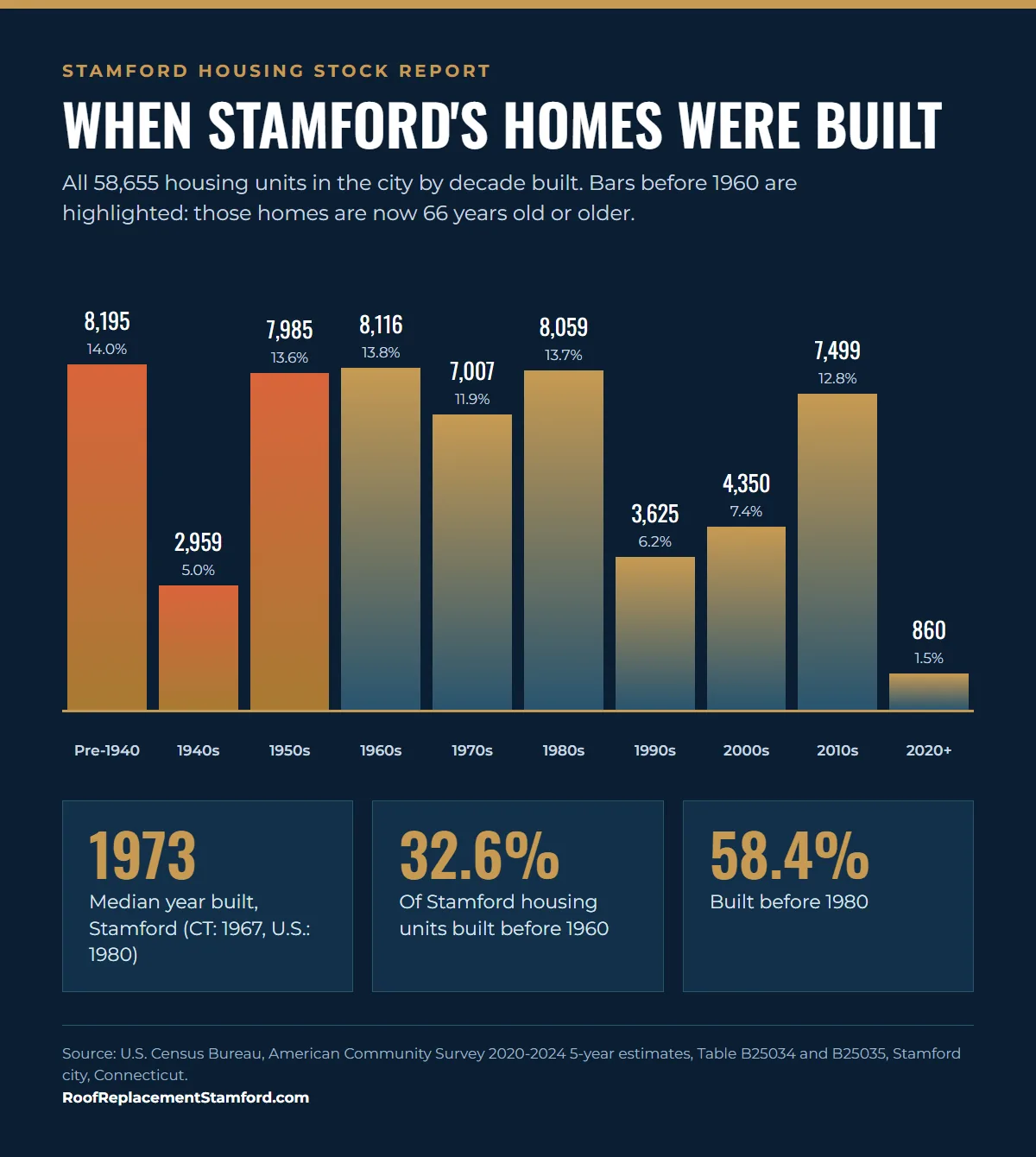
Note what the ACS measures: the age of the building, not the roof. A 1955 colonial may have a 5-year-old roof. What the build year does tell you is how many re-roofing cycles a house has been through, how likely it is to have plank decking, older flashing details or a layer-over, and how much of the city is due for routine replacement in any given decade.
2. Stamford vs. Connecticut vs. the U.S.
Connecticut has one of the oldest housing stocks in the country. CT Mirror's analysis of Census data found that housing built before 1960 makes up 41% of the state's homes, the fifth-highest share nationally, and only one in ten Connecticut structures was built in 2000 or later. Stamford is younger than the state as a whole because of its 1980s office boom and its recent downtown and South End apartment construction, but it is still older than the national stock.
| Metric (ACS 2020-2024) | Stamford | Connecticut | United States |
|---|---|---|---|
| Median year built | 1973 | 1967 | 1980 |
| Built 1939 or earlier | 14.0% | 20.2% | 11.7% |
| Built before 1960 | 32.6% | 40.6% | 25.6% |
| Built before 1980 | 58.4% | 67.2% | 49.7% |
| Built 2000 or later | 21.7% | 12.3% | 25.1% |
| Total housing units | 58,655 | 1,541,822 | 143,775,355 |
Source: U.S. Census Bureau, ACS 2020-2024 5-year estimates, Tables B25034 and B25035. Shares calculated from published unit counts.
| Connecticut context | Value | Source |
|---|---|---|
| Connecticut rank for share of housing built before 1960 | 5th highest | CT Mirror |
| Connecticut rank for share built in 2000 or later | 3rd lowest | CT Mirror |
| Highest pre-1960 share among CT towns (West Hartford) | 65% | CT Mirror |
| Stamford pre-1960 share in an earlier Governing analysis | 41% (lowest among large CT cities with Danbury) | CT by the Numbers, 2017 |
| Stamford pre-1940 share in the same analysis | 16%, the lowest of the large CT cities | CT by the Numbers, 2017 |
| Hartford housing built before 1960 (same analysis) | 66% | CT by the Numbers, 2017 |
Stamford's pre-1960 share has fallen from the 41% Governing reported in 2017 to 32.6% in the latest ACS. The old houses did not disappear; thousands of new apartments were added around them, which dilutes the share. For a homeowner, the takeaway is that Stamford's single-family neighborhoods are as old as ever, as the next section shows.
3. Single-Family Homes by Build Era
Citywide totals mix high-rise apartments with houses. Pitched, shingled roofs sit mostly on one-unit homes, so the ACS table that splits occupied homes by year built and by building type is the better guide to the residential roofing market. It shows a much older picture than the citywide median.
| Occupied single-family homes (detached or attached) | Homes | Share | Source |
|---|---|---|---|
| Built 1939 or earlier | 4,634 | 19.9% | Census ACS B25127 |
| Built 1940-1959 | 6,260 | 26.9% | Census ACS B25127 |
| Built 1960-1979 | 6,311 | 27.1% | Census ACS B25127 |
| Built 1980-1999 | 3,931 | 16.9% | Census ACS B25127 |
| Built 2000-2019 | 2,080 | 8.9% | Census ACS B25127 |
| Built 2020 or later | 96 | 0.4% | Census ACS B25127 |
| Total occupied single-family homes | 23,312 | 100% | Census ACS B25127 |
Source: U.S. Census Bureau, ACS 2020-2024 5-year estimates, Table B25127.
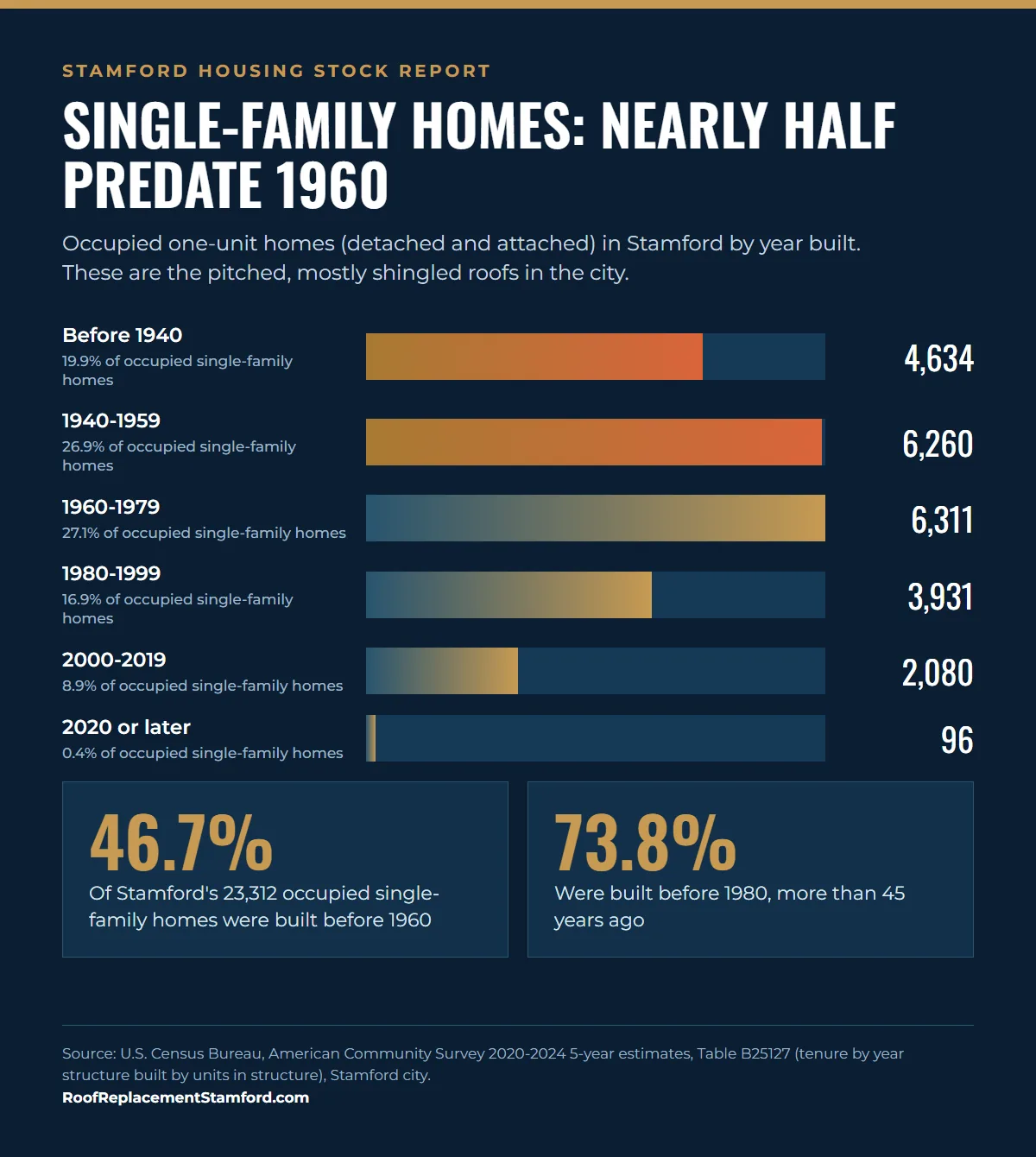
For homeowners this means the typical Stamford house roof is a replacement roof on an old frame. When a contractor opens one up, older plank or board decking, multiple layers and rotted fascia are common things to plan for. Our residential roof replacement page walks through what an inspection checks before a quote.
4. What Kinds of Buildings Stamford Has
Stamford is a city of houses and towers at the same time. One-unit homes are 41.6% of the housing stock, while buildings with 50 or more apartments make up 27.8%, most of them with flat membrane roofs rather than shingles. Just under half of occupied homes are owner occupied.
| Units in structure (all housing units) | Units | Share | Source |
|---|---|---|---|
| 1-unit, detached | 19,811 | 33.8% | Census ACS B25024 |
| 1-unit, attached (townhouses) | 4,575 | 7.8% | Census ACS B25024 |
| 2 units | 3,963 | 6.8% | Census ACS B25024 |
| 3 or 4 units | 4,582 | 7.8% | Census ACS B25024 |
| 5 to 49 units | 9,318 | 15.9% | Census ACS B25024 |
| 50 or more units | 16,318 | 27.8% | Census ACS B25024 |
| Owner-occupied homes | 26,990 | 48.8% of occupied | Census ACS B25003 |
| Renter-occupied homes | 28,301 | 51.2% of occupied | Census ACS B25003 |
| Occupied units in 2-4 unit buildings built before 1960 | 3,784 of 8,142 (46.5%) | Census ACS B25127 | |
| Occupied units in 50+ unit buildings built 2000-2019 | 6,965 of 14,917 (46.7%) | Census ACS B25127 |
Two- to four-family frame houses are a defining building type in older parts of the city such as the South End (see Section 5). If you own one and rent the units, our rental property roofs page covers scheduling a replacement around tenants.
5. Neighborhood Build Eras: Where Stamford's Oldest Roofs Are
The Census does not publish data by neighborhood name, so neighborhood build eras come from National Register of Historic Places (NRHP) nominations, the Stamford Historical Society and development records. Stamford has several NRHP historic districts, and each nomination documents when its buildings went up. We list only build periods a source supports.
| Neighborhood | Documented build era | Details | Source |
|---|---|---|---|
| Long Ridge Village (North Stamford) | 1850-1920 (most development) | 34 historically significant houses and two churches; NRHP 1987 | NRHP listing summary |
| South End | 1870-1930 (most structures) | 449 buildings, almost a fifth industrial; Italianate, Second Empire, Queen Anne, Colonial Revival; NRHP 1986 | NRHP nomination text |
| Shippan Point | Turn of the 20th century | Affluent families "built large comfortable homes on Shippan Point" as the city industrialized | Stamford Historical Society |
| Springdale and Glenbrook | Turn of the 20th century | Offered "attractive suburban homesites at reasonable prices" north and east of the city | Stamford Historical Society |
| Revonah Manor | 1909-1935 | Stamford's first planned neighborhood; laid out 1909; 39 of 50 homes built by 1935; NRHP 1986 | NRHP nomination text |
| Revonah Manor, later infill | Mostly 1955-1960 | The 11 non-contributing homes are mostly ranches from this period | NRHP nomination text |
| Downtown Stamford Historic District | Listed 1983, expanded 1985 and 2002 | Its 1985 boundary increase added 10 Summer Street-area commercial buildings, all built 1910-1930 | NRHP nomination |
| Harbor Point (South End) | 2009 to today | Thousands of apartments built since 2009 on former industrial land; about 4,000 units planned | CT DECD, Stamford Advocate |
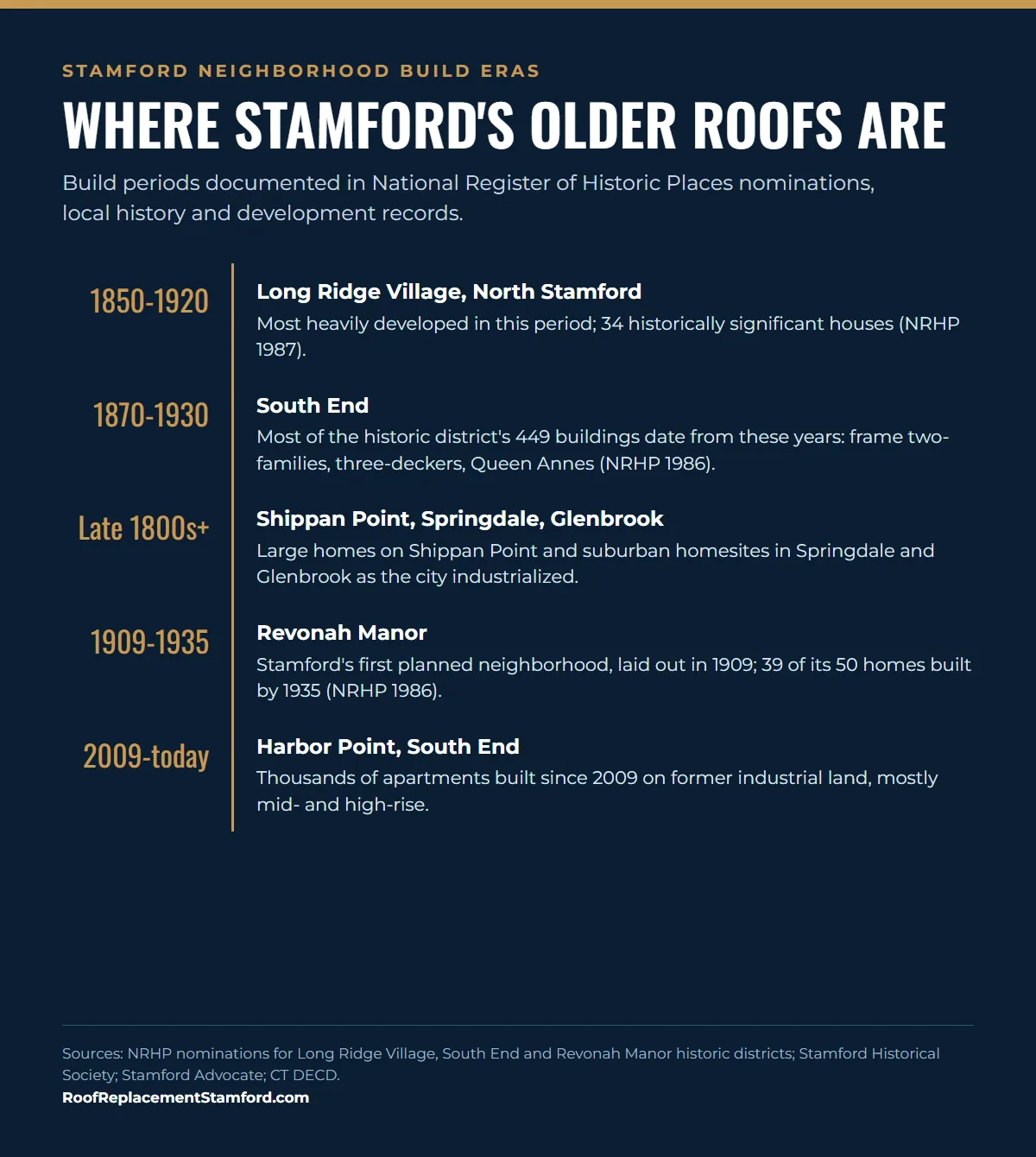
What this means by neighborhood. South End roofing work often involves steep, cut-up roofs on century-old frames, porch roofs and flat rear additions, and the area is under study for a local historic district, so check with the city before changing materials. In Revonah Manor and the older parts of Shippan, Springdale and Glenbrook, a century-old house may have board sheathing and chimneys that need new flashing, and any original slate deserves a repair-first look before replacement. Harbor Point and the downtown towers are commercial flat-roof work; see our commercial roof replacement page for those.
6. The 1990s and 2000s Homes Now Entering the Replacement Window
The newest wave of single-family roofs is the one many owners forget about. A house built in 2005 may still have its original roof, and standard 3-tab asphalt shingles carry a 20-year life expectancy in InterNACHI's chart. Stamford built 7,975 housing units in the 1990s and 2000s combined.
| Build period | Units in Stamford | Age of an original roof in 2026 | Source |
|---|---|---|---|
| 1990-1999 | 3,625 | 27-36 years | Census ACS B25034 |
| 2000-2009 | 4,350 | 17-26 years | Census ACS B25034 |
| 2010-2019 | 7,499 | 7-16 years | Census ACS B25034 |
| Occupied single-family homes built 2000-2019 | 2,080 | 7-26 years | Census ACS B25127 |
| Occupied single-family homes built 1980-1999 | 3,931 | 27-46 years | Census ACS B25127 |
| Life expectancy, 3-tab asphalt shingles | 20 years | InterNACHI | |
| Common CT insurer eligibility limit, asphalt roofs | 15-20 years | CT Insurance Department |
We could not find a published study of how often Stamford's 2000s-era roofs fail, and the ACS does not track roof age, so this report does not put a failure rate on them. The practical step is simple: if your home was built after 1995 and you have never replaced the roof, find out what shingle is on it and how old it is before your insurer asks. A roof inspection answers both questions.
7. How Long Roofs Last
Two widely used references set the expectations that inspectors, appraisers and insurers work from: the National Association of Home Builders' study of home component life expectancy, and InterNACHI's estimated life expectancy chart for home inspectors. Both note that weather, installation quality and maintenance can move the real number in either direction.
| Roofing material | Typical life | Source |
|---|---|---|
| Asphalt shingles, 3-tab | 20 years | InterNACHI |
| Asphalt shingles, architectural | 30 years | InterNACHI |
| Asphalt shingles (all) | About 20 years | NAHB study |
| Wood shakes | About 30 years | NAHB study |
| Fiber cement shingles | 25 years | InterNACHI |
| Built-up roofing (flat roofs) | 30 years | InterNACHI |
| EPDM rubber (flat roofs) | 15-25 years | InterNACHI |
| Slate | 100 years | InterNACHI |
| Clay or concrete tile | 100+ years | InterNACHI |
| Slate, copper and clay/concrete | Over 50 years | NAHB study |
If you are pricing a shingle roof replacement, the shingle grade matters as much as the brand. A home that started with 3-tab shingles in the 2000s is a common candidate for architectural shingles on the second roof.
8. The Northeast Has the Oldest Roofs in the Country
Verisk, the data firm behind much of the property insurance industry's roof analytics, estimates roof ages from aerial imagery and permit data. Its 2026 U.S. Roof Report shows the Northeast with the largest share of very old roofs and the smallest share of new ones, the opposite of the storm-driven South.
| Region (Verisk Roof Age data, 2025) | Roofs 0-4 years old | Roofs 31+ years old | Source |
|---|---|---|---|
| Northeast | 14% | 18% | Verisk |
| Midwest | 21% | 17% | Verisk |
| West | 20% | 11% | Verisk |
| South | 28% | 4% | Verisk |
| U.S. homes showing moderate to poor roof condition | 38% | Verisk | |
| Loss costs, moderate-to-poor vs. good-to-excellent roofs | About 60% higher | Verisk | |
| Roofing's share of line items in property claim estimates | About 30% | Verisk | |
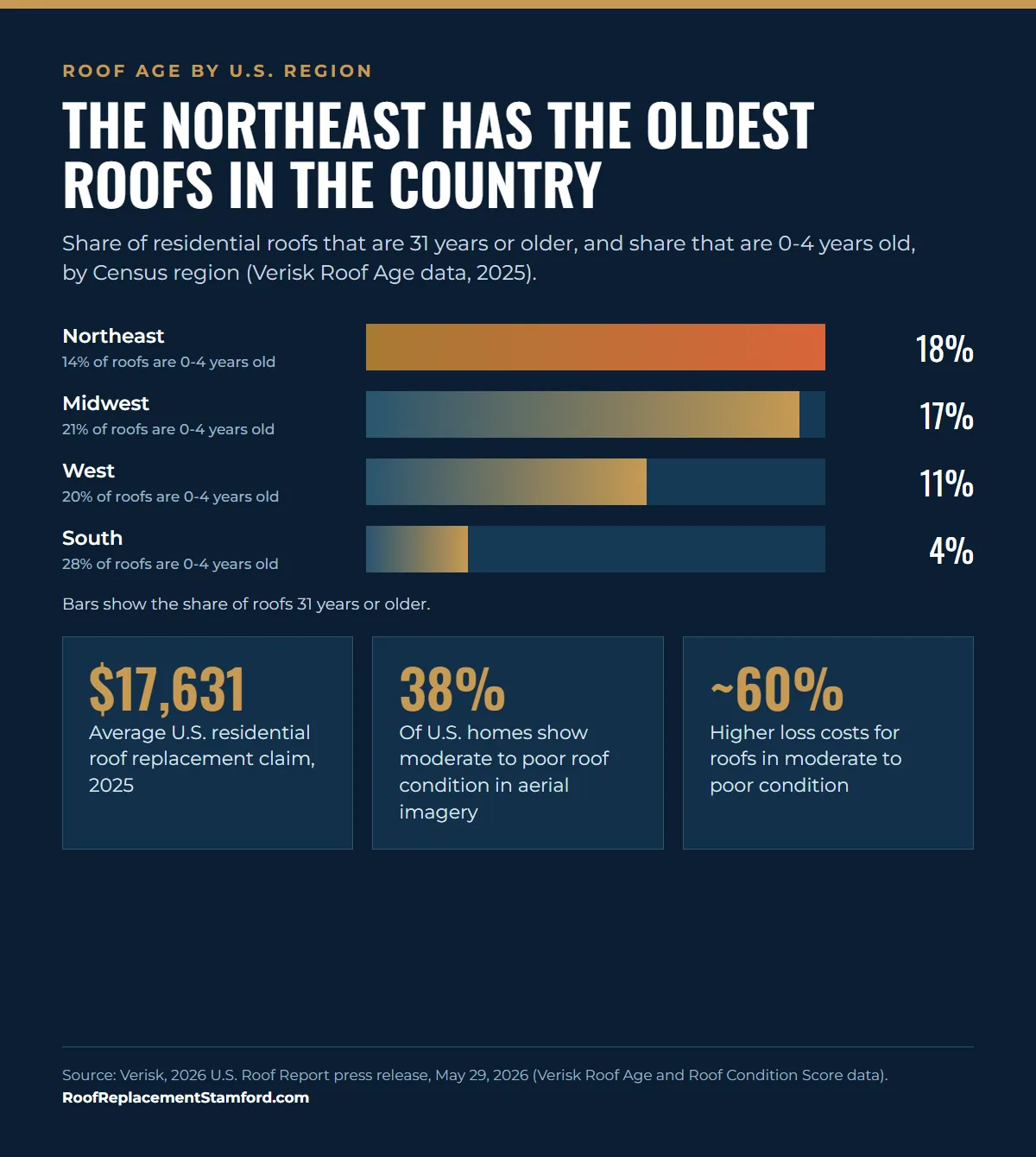
Verisk's numbers are regional, not Stamford-specific, but they match the city's housing data: an old housing stock, relatively little storm-forced replacement, and a large group of roofs that have aged past what insurers like to see.
9. Connecticut Insurer Roof-Age Rules
Roof age has become one of the most common reasons Connecticut homeowners hear from their insurer. In February 2026 the Connecticut Insurance Department (CID) published a consumer advisory explaining how carriers evaluate roofs, including the age ranges they commonly use. Each insurer sets its own guidelines, so these are typical ranges, not state rules.
| Rule or practice | Value | Source |
|---|---|---|
| Common eligibility limit for asphalt, wood, rubber and similar roofs | 15-20 years (varies by insurer) | CT Insurance Department |
| Architectural shingles | Often eligible 25 years or more | CT Insurance Department |
| Tile and slate roofs | Generally treated as lifetime materials | CT Insurance Department |
| Minimum advance written notice of nonrenewal | 60 days, with a clear reason | CT Insurance Department |
| Aerial images showing only cosmetic streaking or discoloration | Should not be used to nonrenew (CID notice, March 2024) | CT Insurance Department |
| Condition issues insurers look for | Missing, lifted, curled or cracked shingles; multiple layers; moss; overhanging limbs | CT Insurance Department |
| Insurer of last resort | CT FAIR Plan | CT Insurance Department |
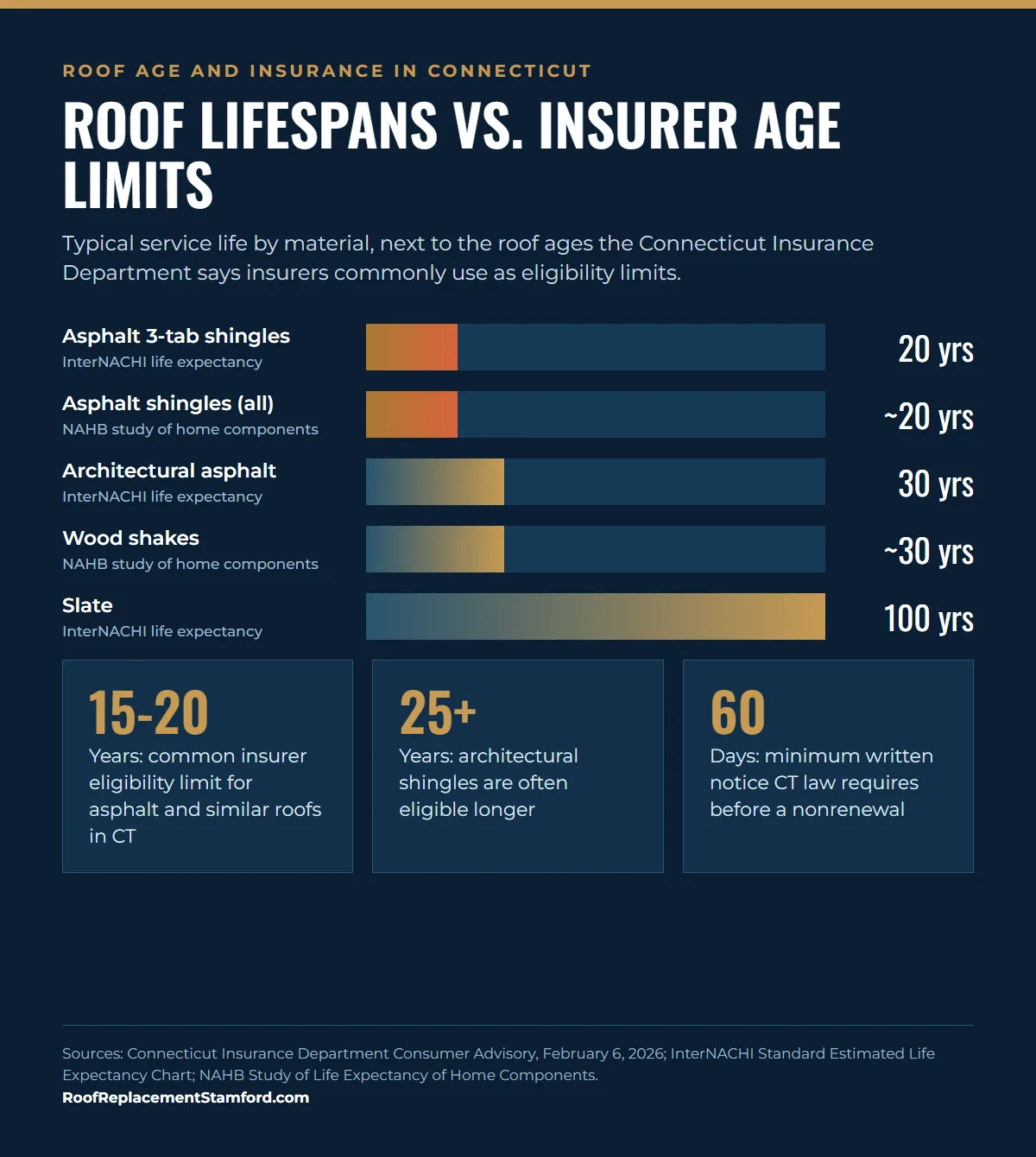
Note that "multiple layers of roofing material" is on the CID's list of condition concerns. That matters in an older city like Stamford, where a 1950s house may already have had one roof installed over another. If you have received a roof-related notice, the CID suggests asking the insurer for specifics and providing documentation of repairs or a scheduled replacement. Our roof insurance claims page explains what a contractor can document for you.
10. Snow Load and Ice Dams on Older Stamford Roofs
Stamford's winters test old roofs in ways Florida's never do. The Connecticut code sets a design snow load for every town, and older homes with thin attic insulation and leaky ceilings are the most prone to ice dams, the main winter roof leak in the region.
| Metric | Value | Source |
|---|---|---|
| Ground snow load, Stamford (2022 CT State Building Code, residential) | 30 psf | CT Residential Code, Appendix AY |
| Ultimate design wind speed, Stamford | 120 mph | CT Residential Code, Appendix AY |
| Normal annual snowfall, Stamford 5 N station | 34.0 inches | NOAA NCEI 1991-2020 normals |
| Normal February snowfall (snowiest month) | 11.9 inches | NOAA NCEI |
| Snow on a roof that can be enough for an ice dam | As little as 2 inches | PNNL Building America Solution Center |
Our companion report on Stamford attic ventilation and ice dams covers the attic side in detail, and the winter roof prep guide covers ice barrier underlayment along the eaves.
11. Roof Resale Value and ROI: Does a New Roof Pay Back?
You will often see the claim that a new roof returns up to 100% of its cost at resale. That figure is real, but it comes from one study and one year. The two national studies measure differently: Zonda's Cost vs. Value Report has real estate professionals estimate the value a fully specified project adds in their market, while NAR's Remodeling Impact Report compares Realtor estimates of added value with remodeler estimates of cost.
| Study and project | Job cost | Value at sale | Cost recouped |
|---|---|---|---|
| Cost vs. Value 2025, U.S.: asphalt shingle roof | $31,871 | $21,501 | 67.5% |
| Cost vs. Value 2025, New England: asphalt shingle roof | $35,701 | $22,346 | 62.6% |
| Cost vs. Value 2025, U.S.: metal roof | $51,865 | $25,972 | 50.1% |
| Cost vs. Value 2025, New England: metal roof | $56,282 | $21,904 | 38.9% |
| Cost vs. Value 2025, Middle Atlantic: asphalt shingle roof | $37,201 | $21,680 | 58.3% |
| NAR Remodeling Impact Report 2022: new roofing | $12,000 | $12,000 | 100% |
| Realtor and homeowner views | Value | Source |
|---|---|---|
| Realtors who recommend sellers put on a new roof before selling (2025) | 37% | NAR 2025 |
| Same measure in 2022 | 33% | NAR 2022 |
| Remodelers seeing more demand for new roofing in the past two years | 43% | NAR 2025 |
| Homeowner Joy Score for new roofing (1-10 scale) | 10 in 2025; 9.2 in 2022 | NAR 2025, NAR 2022 |
| Cost vs. Value 2025 project spec | 30 squares (3,000 sq ft) of laminated shingles, tear-off to sheathing | Cost vs. Value 2025 |
| Markets covered by Cost vs. Value 2025 | 119 | Cost vs. Value 2025 |
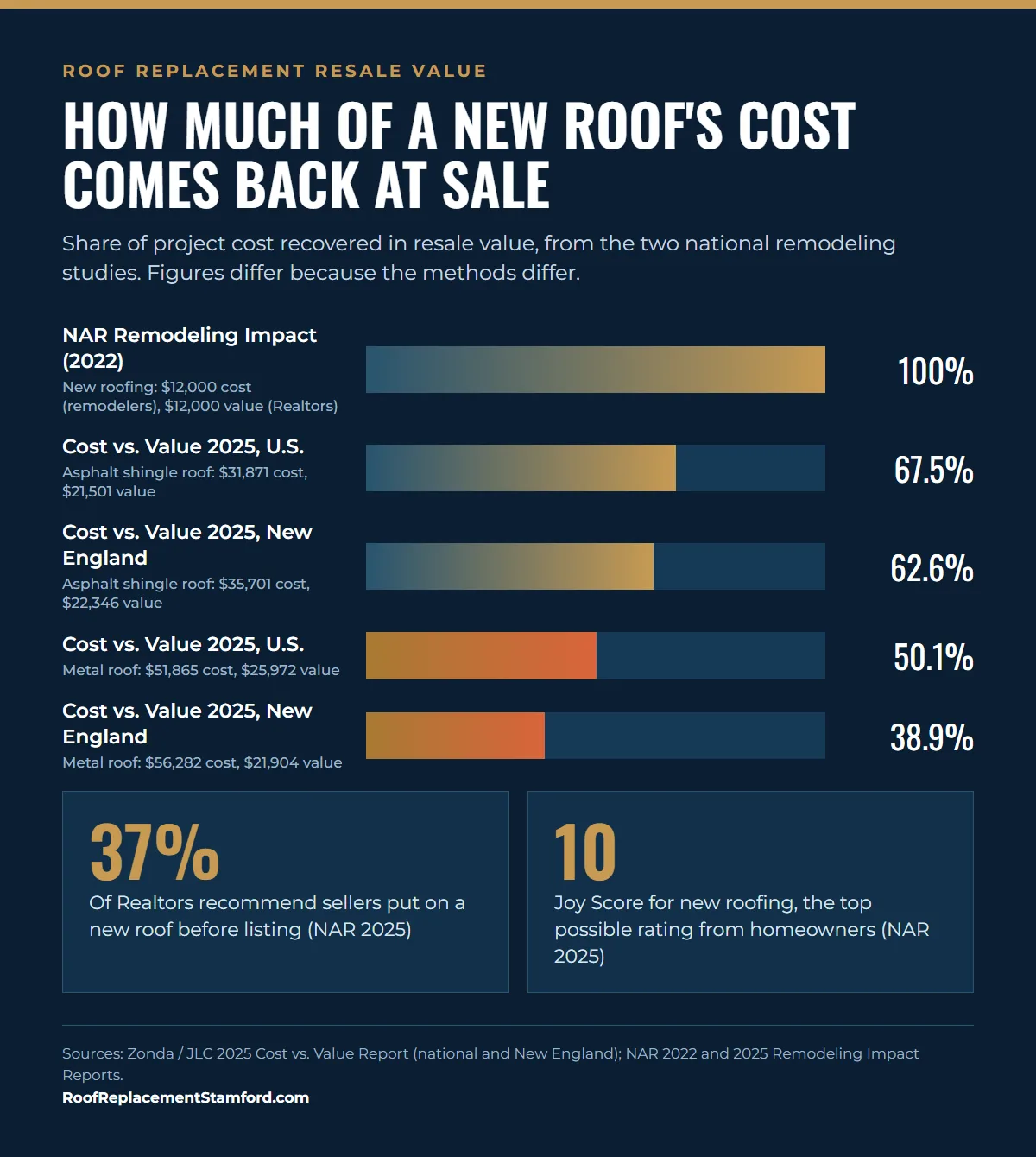
NAR's 2025 report did not publish a cost-recovery figure for roofing, so the 100% number is from 2022 and should not be quoted as current. The fair reading of both studies: a new roof rarely makes money on its own, but an old roof can cost a seller in negotiations, and Realtors increasingly tell sellers to deal with it first. Buyers can get ahead of this with a roof check before buying.
12. What a Roof Costs Against a Stamford Home
Stamford's high home values make a roof a small share of what most houses are worth, even as roof costs rise. Verisk's claims data shows replacement costs climbing faster than the four-year average, driven more by materials than labor.
| Metric | Value | Source |
|---|---|---|
| Median value of owner-occupied homes, Stamford | $624,400 | Census ACS B25077 |
| Median value of owner-occupied homes, Connecticut | $366,900 | Census ACS B25077 |
| New England asphalt roof replacement as a share of Stamford's median home value | 5.7% ($35,701 / $624,400) | Calculated from Cost vs. Value and ACS |
| Average U.S. residential roof replacement claim, 2025 | $17,631 (about 33% above the 2021-2024 average) | Verisk |
| Average U.S. residential roof repair claim, 2025 | $4,699 (about 25% above the 2021-2024 average) | Verisk |
| Change in roofing material costs, 2025 | +1.48% | Verisk |
| Change in roofer labor costs, 2025 | +0.79% | Verisk |
| Residential roof replacement cost value, U.S. claims, 2025 | $23 billion (vs. $24.4 billion average 2021-2024) | Verisk |
The two cost figures above measure different things (a full 3,000 square foot remodeling spec versus the average insured claim), so treat them as a range rather than a quote. Our Stamford roof replacement cost index breaks costs down by home size, material and per square foot. An independent contractor's inspection is the only way to price a specific roof.
13. Summary Table: Stamford Housing and Roof Age Statistics
| Statistic | Value | Source |
|---|---|---|
| Housing units in Stamford | 58,655 | Census ACS |
| Median year built: Stamford / CT / U.S. | 1973 / 1967 / 1980 | Census ACS |
| Stamford units built before 1960 / before 1980 | 32.6% / 58.4% | Census ACS |
| Occupied single-family homes built before 1960 | 46.7% (10,894) | Census ACS |
| Occupied single-family homes built before 1980 | 73.8% | Census ACS |
| Homes built 2000-2009 | 4,350 | Census ACS |
| Units in 50+ unit buildings | 27.8% | Census ACS |
| South End Historic District buildings / build era | 449 / 1870-1930 | NRHP nomination |
| Revonah Manor homes built by 1935 | 39 of 50 | NRHP nomination |
| 3-tab / architectural shingle life | 20 / 30 years | InterNACHI |
| CT insurer asphalt roof eligibility limit (typical) | 15-20 years | CT Insurance Department |
| Northeast roofs 31+ years old | 18% | Verisk |
| Average U.S. roof replacement claim, 2025 | $17,631 | Verisk |
| Stamford ground snow load | 30 psf | CT Building Code |
| Asphalt roof cost recouped: U.S. / New England | 67.5% / 62.6% | Cost vs. Value 2025 |
| New roofing cost recovered (NAR 2022) | 100% | NAR |
| Realtors recommending a new roof before selling | 37% | NAR 2025 |
| Median Stamford home value | $624,400 | Census ACS |
Methodology & Sources
This report was compiled in November 2026. Housing figures use the U.S. Census Bureau's American Community Survey 2020-2024 5-year estimates for Stamford city, Connecticut; shares are calculated from published unit counts and carry the survey's margins of error. The ACS reports when a building was built, not when its roof was last replaced. Neighborhood build eras come only from NRHP nominations, the Stamford Historical Society and development records; neighborhoods without a documented build era are not given one. Roof resale figures use the latest Cost vs. Value Report (2025) and NAR Remodeling Impact Reports. We looked for published home inspection or pre-listing failure rates broken out by roof age and found no primary source, so this report does not include one. The widely repeated "up to 100%" roof ROI figure is from NAR's 2022 report; NAR's 2025 report does not list roofing cost recovery.
- Census ACS B25034, Year Structure Built
- Census ACS B25035, Median Year Built
- Census ACS B25127, Tenure by Year Built by Units
- Census ACS B25024, Units in Structure
- Census ACS B25003, Tenure
- Census ACS B25077, Median Value
- CT Mirror, Connecticut housing age (2024)
- CT by the Numbers, CT city housing age (2017)
- South End Historic District NRHP nomination
- Revonah Manor Historic District NRHP nomination
- Downtown Stamford Historic District boundary increase (NPS)
- Long Ridge Village Historic District summary
- Stamford Historical Society, Condensed History
- CT DECD, Harbor Point
- Stamford Advocate, Harbor Point
- InterNACHI Estimated Life Expectancy Chart
- NAHB Study of Life Expectancy of Home Components
- Verisk, 2026 U.S. Roof Report release
- CT Insurance Department advisory, Feb. 2026
- 2022 CT Residential Code, Appendix AY
- NOAA NCEI U.S. Climate Normals
- PNNL, Ice Dam Prevention guide
- Zonda/JLC 2025 Cost vs. Value Report
- NAR 2022 Remodeling Impact Report
- NAR 2025 Remodeling Impact Report
14. Frequently Asked Questions
How old are homes in Stamford, CT?
The median Stamford housing unit was built in 1973, according to the Census Bureau's 2020-2024 American Community Survey. 32.6% of all units and 46.7% of occupied single-family homes were built before 1960. Stamford's housing is younger than Connecticut's as a whole (median 1967) but older than the U.S. median (1980).
Which Stamford neighborhoods have the oldest homes?
National Register nominations document the South End (most buildings 1870-1930), Long Ridge Village in North Stamford (mostly 1850-1920) and Revonah Manor (laid out 1909, 39 of 50 homes built by 1935). The Stamford Historical Society describes Shippan Point, Springdale and Glenbrook developing as residential areas around the turn of the 20th century.
When do builder-grade shingle roofs need replacing?
InterNACHI lists a 20-year life expectancy for 3-tab asphalt shingles and 30 years for architectural shingles; NAHB puts asphalt shingles at about 20 years. Connecticut insurers commonly start limiting eligibility for asphalt roofs at 15 to 20 years. Stamford's 4,350 homes built in 2000-2009 have original roofs, if never replaced, that are now 17 to 26 years old.
Does a new roof increase home value in Stamford?
The 2025 Cost vs. Value Report estimates that an asphalt shingle roof replacement recoups 62.6% of its cost at resale in New England and 67.5% nationally. NAR's 2022 Remodeling Impact Report estimated 100% cost recovery for new roofing, and 37% of Realtors in 2025 recommended that sellers replace the roof before listing.
Will my insurer drop me for an old roof in Connecticut?
Insurers set their own rules, but the Connecticut Insurance Department says asphalt and similar roofs often face eligibility limits around 15 to 20 years, while architectural shingles may qualify for 25 years or more. Connecticut law requires at least 60 days' written notice of a nonrenewal with a clear reason, and cosmetic streaking alone should not be used to nonrenew.
What snow load does a Stamford roof have to meet?
The 2022 Connecticut State Building Code lists a 30 pounds per square foot ground snow load for Stamford in its residential code appendix. Stamford averages 34 inches of snow a year, and ice dams can form with as little as 2 inches on the roof when warm attic air melts it from below.
Keep Reading
Is Your Roof Older Than Your Insurer Likes?
Talk to an independent local roofing contractor about your roof's age, condition and whether it is time to replace it. Calls are connected 8 a.m. to 9 p.m.
Call +1 203-691-4756 More ways to reach us